

There is a certain silence that isn’t tranquil. When everyone is laughing, and you’re smiling at the appropriate times during a birthday dinner, it manifests as a muted feeling on the inside. It manifests during a dispute when you calmly present the facts while your partner’s voice breaks. It lingers on a Sunday afternoon when the window’s soft, golden light seems to ignore you oddly.
Emotional blunting or “flat affect” are terms used by psychologists to describe it. The phrase “I just feel emotionally flat” is used more casually. Clinicians are careful to frame it differently, even though it may appear to be indifference from the outside. Emotional numbness, according to psychotherapist Dr. Mayra Mendez, who has worked extensively with trauma and mood disorders, is a mental process of blocking out emotions. A protective reduction, not a lack of feeling. That difference is important.
Emotional flatness is frequently a sign of dissociation. When the nervous system is overloaded with stress, trauma, or chronic anxiety, it lowers the volume. The mind is still working. Details remain the same. However, the emotional impact lessens. The system might be prioritizing survival over sensitivity.
| Name | Dr. Mayra Mendez, PhD, LMFT |
|---|---|
| Profession | Licensed Psychotherapist |
| Affiliation | Providence Saint John’s Child and Family Development Center |
| Specialty | Trauma, Emotional Regulation, Mood Disorders |
| Known For | Clinical work on emotional numbing and affect regulation |
| Reference | https://www.verywellmind.com |
It can be confusing to listen to someone calmly and without emotion recount a traumatic childhood experience. The facts are substantial. It has a light tone. Something seems to be missing, not from the narrative, but from the body itself. However, rather than indicating a lack, this gap frequently indicates adaptation.
Researchers studying trauma have long observed that the brain can numb emotions when they become too strong. Cortisol and other stress hormones spike, changing the neural circuits that control emotion. Emotional dampening may result from repeated activation over time. The effect is palpable: joy seems far away, sadness is subdued, and anger is strangely abstract. However, it is still unclear if this reaction is entirely defensive or partially biochemical.
Affect can also be flattened by depression. Many depressive episodes are characterized by grayness, or anhedonia, a diminished capacity for pleasure, in contrast to the cinematic depiction of unceasing crying. People say that relationships feel a little distant, food tastes less colorful, and music sounds duller. Life hasn’t become any less valuable. There’s a drop in the emotional amplifier.
Anxiety also has a role. The mind devotes less energy to feeling subtle positive emotions when it is focused on threat detection, looking for potential problems. The emotional range gets smaller. Even though volatility can occasionally psychologically collapse into flatness, investors seem to think it is all about dramatic swings.
Other people also contribute. Anecdotal evidence has connected some drugs, especially antidepressants, to emotional blunting. Patients frequently report feeling less depressed, but they also report feeling less joyful. Physicians argue about the balance. There may be a price for relief.
Emotional flatness can manifest as a “negative symptom” in psychosis and other severe mental illnesses, such as decreased self-esteem, low motivation, or diminished expression. Mental health organizations stress that worsening patterns can be avoided with early intervention. However, flatness does not always indicate a serious illness. Context is important.
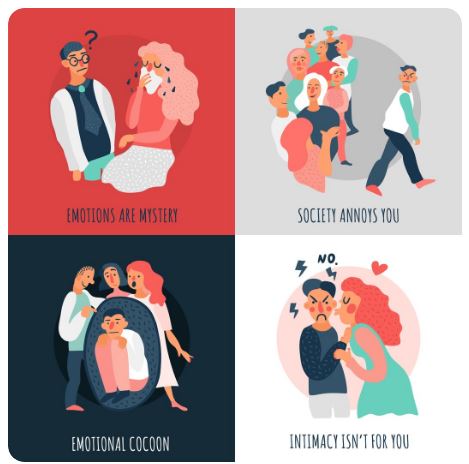
Emotional control is frequently rewarded in this culture. Being able to remain calm under pressure is regarded as maturity in high-performance settings. When kids receive praise for being “so calm,” they might internalize this trait as their identity. There’s a belief that strength comes from displaying less emotion. Even when safety no longer calls for it, this acquired poise can eventually become instinctive.
Emotional flatness can cause silent rifts in relationships. One partner asks for confirmation, while the other offers a logical response. Although the conversation’s content may be accurate, there is a lack of emotional connection. It’s difficult to ignore how frequently miscommunications result from this mismatch: one person shielding themselves from stress, the other taking distance as rejection.
A related idea in psychology is “isolation of affect,” which is the process of distancing emotion from story. You are able to narrate events with clarity while avoiding the emotional burden they carry. Short-term adaptation of this defense is possible, especially during emergencies. However, it restricts intimacy, not only with others but also with oneself, once it becomes ingrained.
Moreover, burnout plays a part. Emotional resources are depleted by ongoing stress. Long hours and continuous stimulation can cause the body to go into conservation mode. Then, flatness becomes more about tiredness than trauma. Depletion could be the cause of the sensation of emptiness.
When it does occur, reconnection usually occurs gradually. Instead of pursuing strong emotions, therapists frequently advise beginning with body awareness. Take note of the jaw’s tightness. the sensation of a heavy chest. Feelings may come after sensations. Without overburdening the system, emotional labels like “tender,” “disappointed,” and “uneasy” can restore nuance.

Safety is important. Unlike numbness, emotional safety is the capacity to experience discomfort without shutting down. There is growing evidence that numbness limits regulation, whereas safety facilitates it. Though subtle, the difference is significant.
During this process, it’s difficult not to feel a silent compassion for the mind. Rarely does emotional flatness appear out of the blue. It develops through experience, from moments when experiencing too much was dangerous. The system adjusts. The volume drops.
It then becomes a question of whether that adaptation is still useful.
It’s nearly impossible to notice when someone is hesitantly allowing themselves to feel again, whether it’s a brief moment of joy or sadness. However, it means that flexibility is coming back. expansion of the emotional spectrum. The nervous system is evaluating if it is currently safe.
Being emotionally flat is not a sign of being broken. It’s usually proof that you’ve been through something. Perhaps the most significant insight is that feeling emotionless is not the same as feeling flat. It’s the mind’s subdued way of expressing that it once required defense and might be prepared to gradually remove it.