
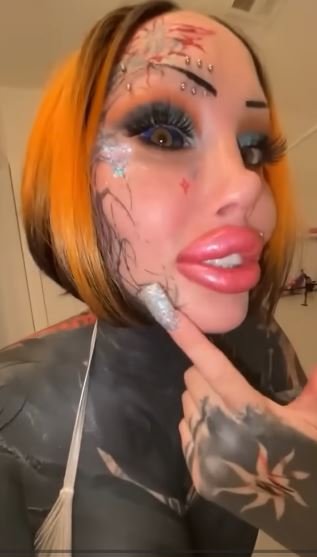
Not too long ago, Mary Magdalene’s name appeared on social media feeds in a nearly consistent pattern. A new process. An issue. A selfie of defiance. People followed her because they couldn’t quite take their eyes off of her, not because they admired or disapproved of her, and she lived in that strange digital realm where fascination and discomfort completely overlap. Her real name was Denise Ivonne Jarvis Gongora. She was born in Canada into a deeply religious family where even Disney movies were allegedly prohibited. By the time she passed away in Thailand last December at the age of 33, she had reportedly spent over half a million dollars reshaping nearly every part of her body. From a sheltered suburban upbringing to becoming a global tabloid fixture, that path seems less like a celebrity arc and more like a case study in an area that no one has yet fully understood.
Although the number of procedures was astounding, it wasn’t what set Mary Magdalene’s story apart. It was the openness. She freely expressed her desire to become a “mutant hybrid apocalyptic otherworldly goddess.” Plastic surgery is a hobby, according to her. She traveled to Russia, Mexico, and other countries for operations that defied convention because she described procedures that the majority of surgeons in the United States would not carry out. One of her signature 38J breast implants burst, leaving her with what she publicly referred to as a “uniboob.” During a procedure to create what she claimed would be “the world’s fattest vagina,” she once came dangerously close to death and needed two emergency blood transfusions. These were not low-key medical incidents. She described them all on the internet, at times with obvious distress and at other times with dark humor.
It’s difficult to ignore how engrossed she was in the internet. Millions of people watched, made comments, shied away, expressed sympathy, and shared memes. It appeared that fewer people knew she was also a painter. Her Instagram art account displayed work with real talent and emotional depth, but the deluge of body-focused content overshadowed those pictures. Her pieces could have sold for thousands of dollars even without her notoriety, according to a Reddit commenter who claimed to work in the art sales industry. That particular detail lingers. It seems as though the person behind the persona was constantly overshadowed by the spectacle that she had both created and been thrust upon.
Even devoted fans were unnerved by the eerie quality of her last hours. She shared a screenshot of Jim Carrey’s character bowing and saying goodbye in the final scene of The Truman Show, along with what looked to be a childhood photo of herself, shortly before she passed away at the Patong Tower hotel in Phuket. One of her Instagram accounts was allegedly changed to “MaryMagdaleneDied.” Within ten minutes of checking in, the reception staff reported to the police that she had gone up to her room on the ninth floor and fallen from the balcony. Her slippers were discovered by the officers on the balcony. Her body was transported to Vachira Phuket Hospital for examination, and the circumstances are still being investigated.
The debate over extreme body modification frequently revolves around the same points of contention: bodily autonomy versus exploitation by unlicensed surgeons, personal freedom versus mental illness. All those wires were impacted by Mary Magdalene’s life. At twelve, she began to rebel; by seventeen, she was employed as a stripper; and at twenty-one, she underwent her first cosmetic procedure in Mexico. That process was a disaster. She was unaffected by it. If anything, the difficulties seemed to fuel the next procedure, and then the next, establishing a pattern that both strangers on the internet and those close to her could recognize but were unable to break. She was described by several Reddit users who had followed her for years as being genuinely kind, humorous during her Instagram Lives, and obviously looking for something that surgery alone would never be able to provide.
It’s genuinely unclear if her story has any bearing on how platforms handle extreme body content or how the cosmetic surgery industry regulates its periphery. The impression of a woman who painted quietly, spoke honestly, and never quite found the version of herself she was searching for endures, at least for those who looked past the shock factor.
Please contact a crisis helpline in your nation if you or someone you know is having difficulties. Call or text 988 to reach the 988 Suicide and Crisis Lifeline in the United States.