
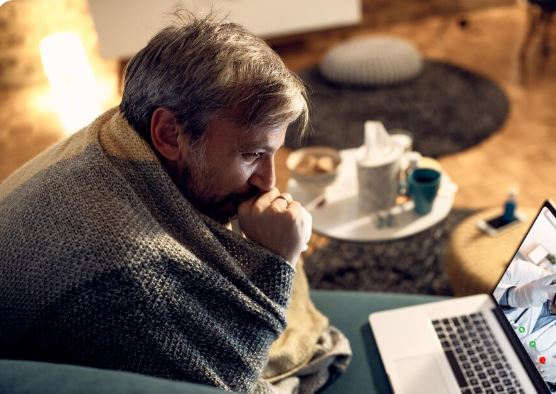
I opened my laptop on a Tuesday night in early spring, somewhere between dinner and exhaustion, and hesitated. A tiny square on the screen showed my therapist’s face. She grinned, and we began. It wasn’t dramatic, but it was softly reassuring.
In the UK, online treatment has developed with unexpected tenacity. For many, what started out as a backup plan during lockdown has evolved into their go-to source of assistance. Not a stand-in. A first choice.
| Feature | Description |
|---|---|
| Clinical Effectiveness | Comparable to in-person therapy for anxiety and depression |
| Safety Measures | Encrypted platforms, registered professionals (BACP, UKCP) |
| Affordability | Often more cost-effective, starting around £30 per session |
| Accessibility | Particularly beneficial for rural areas, disabled clients, and busy lives |
| Limitations | Less suitable for severe mental illness or mental health crises |
| Technological Needs | Requires stable internet and private space |
Recent research have demonstrated that online Cognitive Behavioural Therapy, in particular, is surprisingly similar in effectiveness to its in-person equivalent. People with anxiety and depression, the most frequent therapy requirements, generally report meaningful improvements—some even faster than they might with traditional weekly office sessions.
That’s partly owing to how rapidly internet sessions can be organized. In most situations, rehabilitation begins in days, not weeks. Some platforms offer appointments within 24 hours. This kind of immediacy is particularly effective at periods of emotional urgency—those times when waiting feels like standing motionless in a storm.
The financial advantage is substantial, too. Although online sessions often start around £30, private therapy has traditionally been associated with high costs. The value is particularly noticeable for people who are juggling several obligations without the additional costs of travel, child care, or time off work.
Then there’s geography. A trauma-informed therapist in London can now deal with a resident of a sleepy seaside town. A few years ago, that was not even an option. By removing physical distance, online therapy has dramatically widened access to specialist care—something formerly limited to urban centres.
Still, there are trade-offs. A therapist previously explained the modest difficulties of recognizing a client’s twitching hands or shifting posture through a computer. Those subtle cues—often unspoken but highly revealing—can be tougher to discern distantly. In difficult circumstances, when detail matters greatly, that disparity may carry weight.
Some therapists claim they’ve adapted by listening more closely to tone, by becoming more responsive to language and silence. Yet for certain clients, especially those who struggle with emotional expression or feel emotionally flat, that extra distance can feel like a wall.
The digital context necessitates a certain level of privacy and stability. Not everyone has a room where they may speak freely, or a reliable internet connection. Last year, I spoke with a client who talked about trying to get to therapy while parked outside a gym with their phone poised on the dashboard. They chuckled and said, “It wasn’t ideal, but it was better than nothing.”
The safety procedures for internet therapy are, by most accounts, very explicit. Healthcare systems trust encrypted platforms, which are used by reputable providers. Therapists must also be registered with professional groups like the BACP or UKCP. These protections are essential to fostering trust and go beyond simple regulations.
Of course, internet therapy isn’t meant for every case. For patients in crisis or suffering with psychosis, distant care lacks the immediacy and intensity that face-to-face contact delivers. There are boundaries that digital care shouldn’t attempt to transcend, even among therapists who support it.
However, internet therapy is proving to be not just sufficient but frequently amazingly beneficial for a wide range of individuals—those dealing with grief, work stress, identity issues, or life transitions.
I was informed by a retired instructor that she felt better at ease during her sessions on video. “I didn’t feel compelled to perform. I cried more. I think that helped.” Her comment echoed something I’d heard from a therapist in Sheffield: “Sometimes, being in your own environment helps you open the door just a little wider.”
There’s something particularly inventive about the way therapy has changed. It’s no longer constrained by office walls or business hours. Evening sessions. Weekend check-ins. Schedules are shaped to fit lives by therapists and clients, not the other way around.
For younger adults—digital natives already accustomed to screen-based conversations—the online format frequently feels intuitive. For working parents, it eliminates logistical juggling. It’s an invitation to fully participate for people with mobility issues or disabilities.
Some still miss the physical space of a treatment room—the rituals of arrival, the chair, the small conversation at the door. But others think logging out gives a kinder exit, a moment to breathe before re-entering regular life.
I’ve spoken with therapists who’ve created entire practices online, and they speak with guarded optimism. They know it’s not perfect. But they also know it’s working.
That Tuesday, my own session came to a calm end. After making tea and clicking “leave,” I sat quietly for a time. Therapy hadn’t become less meaningful just because it was virtual. If anything, the accessibility made it more sustainable. It’s more likely to occur again the following week.
It’s not a revolution cloaked in headlines. It’s a slow, thoughtful shift. And for individuals who’ve spent years reluctant to seek for help, the promise of rapid, private, flexible treatment can be just what motivates them to try.