
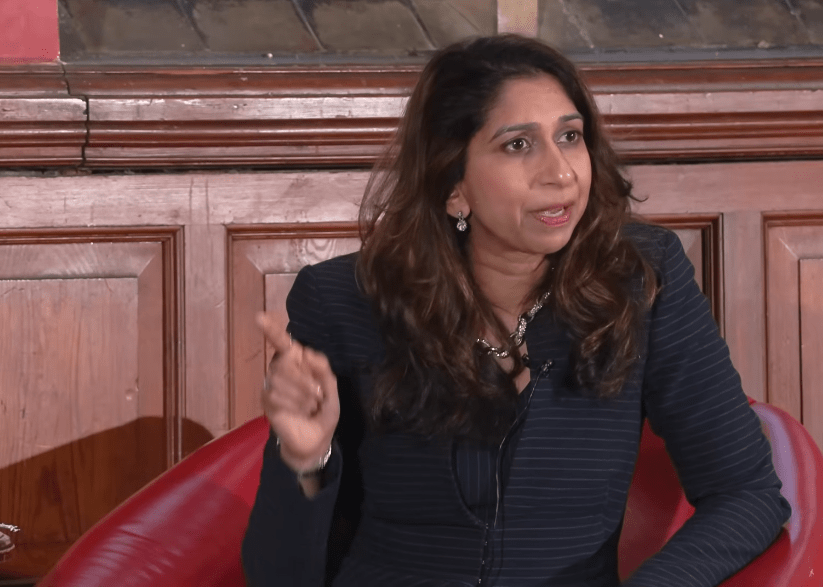
Credit: OxfordUnion
The sentence was simple, but its ramifications were far-reaching. “We did all we could to look after Suella’s mental health.” That single line, buried inside an official Conservative Party press release, triggered condemnation from all corners.
Shared immediately after Suella Braverman’s decision to join Reform UK, the comment was quickly deemed an error and removed. But by then, the harm had been done.
| Name | Suella Braverman |
|---|---|
| Profession | Barrister and political leader |
| Political Career | Former Home Secretary, Attorney General, defected to Reform UK in Jan 2026 |
| Mental Health Controversy | Tory statement linked her defection to mental health, later retracted |
| Public Response | Widely condemned by charities, politicians, and the public |
| Official Apology | Kemi Badenoch apologized for the incident and retracted the comment |
| External Source | BBC |
Mental health charities, political friends and rivals, and members of the public responded with severe censure. The line was considered not only as unprofessional, but as a public betrayal of personal trust.
The statement inferred a causal link between Braverman’s political decision and her state of mind. It was a strategy that was quite similar to traditional character smearing, but the consequences felt more severe and even hazardous in the setting of mental health.
Conservative Party leader Kemi Badenoch apologized swiftly, adding the language was “completely wrong” and that she had personally confronted the person responsible. But for many watching, the apology come too late to erase the hurt.
For her part, Braverman called the statement “pathetic.” Her tone in interviews was forceful and calm. She appeared more irritated than wounded. It was, as one observer noticed, the posture of someone used to being mischaracterized.
Braverman’s decision to leave the Tories wasn’t impulsive. It followed months of rising conflict, mainly over immigration and what she regarded as a lack of ideological backbone in party leadership. She joined other high-profile defectors including Robert Jenrick and Nadhim Zahawi, giving Reform UK substantial momentum.
The Conservatives may have reacted in a panic as a result of that momentum. But seeking for mental health as an explanation crossed a barrier many had assumed British politics had transcended.
The outcry was quick and diverse. Labour MP Sojan Joseph condemned the statement as “frankly appalling.” Tom Pollard from Mind termed it “disappointing” and “stigmatizing.” Even Braverman’s policy detractors came forward to condemn the assault.
Using mental health to earn political points isn’t just insensitive—it is particularly detrimental at a time when public health initiatives are working hard to normalize mental wellbeing discourse.
By alleging emotional instability instead of arguing policy, the Conservatives attracted criticism that was not only bipartisan but extremely personal for many. For professionals and regular people experiencing mental health problems, the message implied their challenges may be used against them if they strayed out of line.
Braverman’s track record includes previously asking for mental health to be handled with the same urgency as physical health—a position that many regarded significantly progressive at the time. That context made the party’s messaging even more disturbing.
I remember reading one MP’s reply that likened the statement to a “first draft email you regret sending.” But this wasn’t simply a first draft. Attached to an official press line, it was made available to journalists. Someone felt it was useful—until public response proved otherwise.
And here’s what remained with me: even politicians as contentious as Braverman deserve the honor of being discussed on their beliefs, not pathologized for their judgments.
The entire affair indicates a deeper unease within political ranks about handling dissent. When a high-profile figure breaks ranks, the reaction should be anchored in ideas, not insinuations about emotional health.
This concerns because political life is already incredibly stressful. Mental resilience is tested routinely by public scrutiny, media pressure, and personal conflict. To weaponize mental health in that atmosphere is not simply unethical—it’s unstable.
Badenoch’s following remarks simply increased confusion. She apologized for the original statement, then dubbed defectors “drama queens” in the same breath. It became more difficult to determine the party’s true position due to the tone shift from conciliatory to contemptuous.
What the people heard was contradiction.
Mental health specialists have underlined time and again that privacy, especially when it comes to psychological welfare, must be respected. Employers—political or otherwise—should not allude to an individual’s mental health without authorization. Doing so breaks a line that is not simply professional, but human.
One benefit of this incident is that it spurred a long-overdue discussion. It reminded many that dignity in debate should still be possible, especially despite the heat of political realignment.
Suella Braverman’s political career may not appeal to everyone. Her policies—particularly on immigration and policing—have aroused considerable resistance. However, we all lose something when criticism gets into the realm of personal health: decency.
In recent years, efforts surrounding mental health awareness has been very effective. Better language has been used in workplaces. Schools have introduced better resources. Public people have spoken openly, helping to normalize therapy and drugs.
But one casual statement like this one can undo a lot. It reminds us that words, especially from those in power, carries weight.
If there’s something optimistic to take from the outcry, it’s that people were paying attention. It was called out. No, this is no longer acceptable, they said.
That instinct—to safeguard the integrity of mental health conversations—is, in itself, a sign of progress. Let’s carry that forward. The next time someone deviates, disagrees, or upsets the status quo, let’s make sure we ask better questions instead of relying on outdated practices.
Because even in politics, empathy should never be optional.