
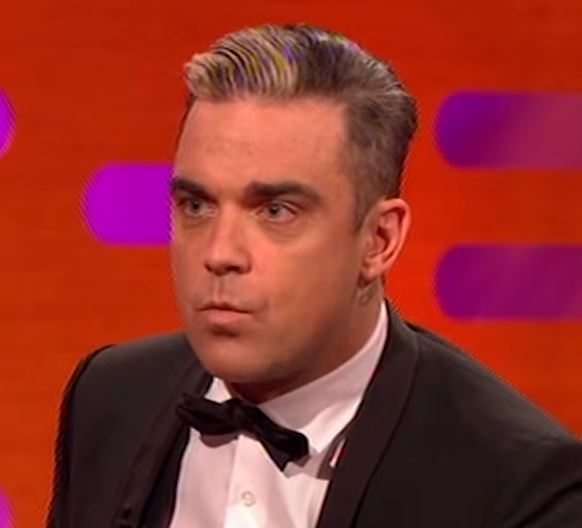
Robbie Williams talks about his face in a way that is almost recklessly generous. The majority of celebrities handle cosmetic procedures like classified intelligence; they may mumble something about drinking water, deny everything, or give credit to good genes. In contrast, Williams, who recently turned fifty, still exudes the restless energy of a man who hasn’t quite found his identity. His Instagram posts about it have the kind of humorous timing that makes you forget he’s talking about something that is actually painful. A 2023 caption joyfully described having fillers, Botox, and “something done to my chin that made me look like Desperate Dan.” The part about Desperate Dan wasn’t a joke either. Or perhaps he was. The boundary between punchline and confession has always been incredibly thin for Williams.
Pieced together from interviews spanning more than ten years, the cosmetic history reads like a man trying different keys in the same lock. In 2013, he had a hair transplant, which he claimed he didn’t really need at the time. He attributed this to living in Los Angeles, where aesthetic procedures are practically atmospheric. Ayda Field, his wife, put it simply: if you live in Los Angeles long enough, surgery will happen to you. Around 2020, the hair began to truly thin, and because the remaining hair was too fine, no one would give him another transplant. He experimented with follicle growth injections. They were ineffective. He even suggested wearing one of those contemporary adhesive wigs that require shaving your head for touring. He might have been half-serious.
The mid-to-late 2010s saw the introduction of Botox and fillers. Williams noted that he could no longer move his forehead properly when he told the Daily Mail that he had had work done on his chin and forehead. He seemed to find this completely predictable and ridiculous at the same time. Seated next to Justin Timberlake, Daniel Radcliffe, and Anna Kendrick on the Graham Norton Show, the makeup appeared to be noticeable enough for the audience to notice. Williams did not dodge. Seldom does he. He gained weight after the liposuction, and the fat simply reappeared in different places, migrating to his arms as if it had its own agenda. This dark comedy is discussed elsewhere.
The body dysmorphia, which Williams has addressed with a candor that truly shocks, is what elevates all of this above tabloid inventory. He stated that his “ideal goal weight is people being worried about me” in an Instagram post from 2023 after experiencing a noticeable weight loss. He spoke of decades of self-loathing that were almost clinical in their severity. The weight swings, which occasionally amounted to forty pounds or more in either direction, were not the result of celebrity diets gone awry or lifestyle decisions. They were signs of a more serious condition that cannot be cured by improved fillers or more modern transplant methods.
After losing two stones, Williams was thinking about getting filler around his eyes in 2023 to address what he described as a “hollow” appearance. He cited Vaseline as his main skincare product and mentioned that Marilyn Monroe was said to have used it. It’s a stunning Robbie Williams detail, evoking the most famous face in Hollywood while looking for under-eye filler. He made an appearance on Watch What Happens Live earlier this year, flaunting his new veneers, joking that they replaced “the yellow knobs” he once had, and expressing regret for an uneven spray tan that left him looking “covered in gravy.” The audience chuckled. They never stop laughing. Williams has mastered the art of making vulnerability engaging enough to keep viewers’ attention.
Here, the larger context is important. According to the British Association of Aesthetic Plastic Surgeons, male cosmetic surgery has increased dramatically in the UK over the past ten years, with double-digit percentage increases in procedures like liposuction, brow lifts, and eyelid surgery. Williams is not an anomaly. He’s the only one who is open to conversation. Furthermore, there’s something subtly noteworthy about a man of his age and platform acknowledging that none of the procedures, injections, or transplants have truly fixed the issue. According to him, the sadness is genuine, startling, and enduring. It won’t lessen. It’s difficult to gauge whether that candor benefits anyone else sitting with similar emotions. However, it’s difficult to ignore the fact that he continues to say it.