
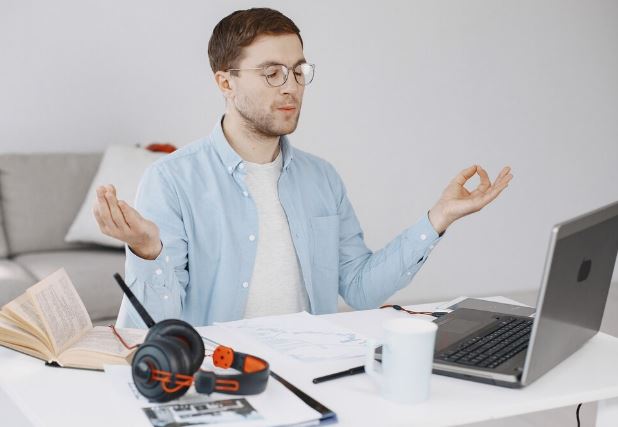
Many people thought something nearly utopian would happen when offices were cleared out in 2020. No need to commute. No fluorescent lights. No awkward silences in elevators. The idea was straightforward: people’s anxiety would decrease if they were given control over their schedules.
Even so, it’s difficult to ignore the fact that the tension hasn’t gone away after a few years. Sometimes it has simply changed form.
The goal of flexible work—remote, hybrid, and flextime—was to bring equilibrium back. More job flexibility is associated with less psychological distress, according to research conducted by Monica Wang at Boston University School of Public Health. The numbers appear encouraging, even comforting, on paper. Related national analyses found that states with more workplace flexibility had lower rates of depression. The idea that autonomy lowers stress seems reasonable.
| Category | Details |
|---|---|
| Study Focus | Job Flexibility & Mental Health |
| Lead Researcher | Monica Wang |
| Institution | Boston University School of Public Health |
| Data Source | 2021 National Health Interview Survey (18,000+ U.S. adults) |
| Key Finding | Greater flexibility linked to lower distress—but context matters |
| Published In | JAMA Network Open |
| Reference | https://jamanetwork.com/journals/jamanetworkopen |
However, something feels different when you’re strolling through a residential neighborhood at 2:00 p.m. on a Wednesday with laptops glowing at kitchen tables and curtains half-drawn. Yes, people are at home. However, many people aren’t exactly at ease.
Even though there is no longer a commute, the workday seems to go on forever. Long after supper, the laptop remains open on the dining table. Late into the evening, Slack notifications begin to blink. Previously delineated by office doors and train platforms, the line separating personal and professional life has become hazy. Flexibility might have subtly changed into constant availability.
Some scholars refer to this as the “flexibility paradox.” Employees who have more control over their work schedule and location tend to work longer hours, log on earlier, sign off later, and complete tasks that were previously reserved for the morning. Sometimes, the autonomy that offered respite turns into pressure that is put on oneself.
A subtle psychological change is also at work. Out of sight, out of mind is a subtle but enduring concern that arises when one is physically absent from an office. Workers who are worried about promotions or layoffs frequently overcompensate by answering emails right away, offering to take on extra work, and staying active online. Observing this across industries, it seems that anxiety has increased in internalization rather than decreased.
Another layer is added by hybrid models. At work one week, at home the next. schedule changes. Changing expectations. Whether this intermediate structure generates more uncertainty than stability is still up for debate. Leadership in some organizations quietly rewards those who show up most frequently while promoting flexibility as a benefit. When proximity bias occurs, it raises subliminal concerns about justice.
Another factor is social isolation. Video calls felt new in the early days of remote work. Now, it can be exhausting to stare at a grid of muted faces. The impromptu discussions, those conversations in the hallway, the shared giggles over sour coffee, have mostly vanished. Once natural, mentoring now needs to be scheduled. It can be difficult for junior staff members in particular to feel seen.
However, many workers have undoubtedly found that flexibility has made it easier to manage daily logistics, medical appointments, and caregiving. Just not having to commute can reduce stress. However, adding flexibility to already-existing stressors like growing living expenses, unstable employment, and performance standards linked to steady output doesn’t always result in peace. It might just shift the stress from the highways to the offices at home.
This is made worse by technology. Tools that increase transparency, such as read receipts, productivity dashboards, and monitoring software, can also make people more self-conscious. Employees may feel watched, even if they are not being directly monitored, as their work is evaluated against unobservable benchmarks. Ease is rarely fostered by that silent hum of evaluation.
Then there is the expectation of culture. Resilience and flexibility are now interchangeable terms. It is expected of employees to be flexible, juggling work and personal obligations while still delivering high-quality work. The dual load can increase anxiety rather than lessen it, particularly for parents and other caregivers.
Still, calling flexible work a failure would be oversimplified. According to research published in JAMA Network Open, mental health improves when job security, flexibility, and clear expectations are combined. The subtlety is important. When flexibility is unbridled, chaos results. Without trust, flexibility turns into surveillance.
It’s possible that culture, not geography, is the real problem. Flexible arrangements merely extend the stage if organizations gauge commitment by outward busyness rather than outcomes. Employees will notice if managers send emails at midnight. Anxiety endures if utilizing flexible policies seems dangerous.
It’s easy to think that altering our workplace will instantly alter our emotions. But geography is only one aspect of work. It’s insecurity, ambition, expectation, and hierarchy. Bringing it inside the house doesn’t make those forces go away.
As you observe this development, a subtle lesson becomes apparent. Systemic stress cannot be resolved by flexibility alone. Clarity, equity, and sincere consent to disconnect must be included. If not, the promise of balance turns into just another act.
It’s possible that flexible work will live up to the initial optimism. But only if it is viewed as a structural redesign based on human limitations rather than as a benefit or a way to cut costs. The laptop on the kitchen table will remain lit late into the night until then, anxiety lingering, freedom flickering.