
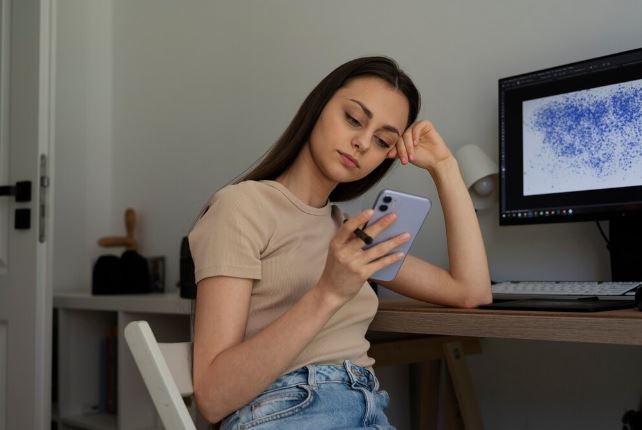
After visiting enough therapy offices, you begin to recognize a certain face. It’s the expression of someone who has just been politely asked how often they check their phone. The silence. The fast, somewhat defensive recalculation. Then the response, which is typically accompanied by a little chuckle: more than they’d like to acknowledge. A clinician in north London informed me that she no longer asks the direct question. She merely observes. Most patients reach for their phones at least twice within ten minutes of sitting down, frequently without realizing it.
This gesture, which is performed millions of times daily in every waiting room and commute, is at the core of what researchers now refer to as “digital overload,” and an increasing amount of research indicates that it may be seriously harming our emotions. The pattern is difficult to overlook, but the connection isn’t straightforward and hasn’t been proven yet. According to WHO estimates, 301 million people worldwide suffer from anxiety disorders. Adults in America now spend an average of thirteen hours a day in front of screens. According to a 2017 UK study, smartphone users unlock their phones roughly 85 times a day. This was not what the brain was meant to process.
| Topic | Digital overload and its link to anxiety disorders |
| Global anxiety disorder cases | 301 million people (most recent WHO estimate) |
| Average daily screen time, US adults | Around 13 hours across phones, laptops, TVs, tablets |
| Recommended non-work screen time | Under 2 hours per day |
| Average phone unlocks per day (UK study) | ~85 |
| Reported sources of stress | News, notifications, social comparison, FOMO, sleep disruption — see Stress in America 2025 |
| Key biological mechanism | Sustained activation of the fight-or-flight (sympathetic) response |
| Sleep impact | Blue light suppresses melatonin; it correlates with insomnia |
| Treatment gap | Only about 1 in 4 with an anxiety disorder receives any care, per ADAA |
| Common interventions | CBT, mindfulness, scheduled tech-free periods, and limited social media |
When neuroscientists describe the mechanism, it sounds almost embarrassingly literal. It dings with a notification. Cortisol pushes upward. The tiny, almond-shaped piece of ancient wiring known as the amygdala emits a weak version of the same signal that it would send if a predator emerged from the trees. The nervous system spends the majority of the day in low-grade fight-or-flight mode when you multiply that by every email preview, every red badge, and every push alert from a news app whose sole purpose is to keep you slightly alarmed. A true predator does not exist. The body is unaware of that.
The phrase “doomscrolling” endured the pandemic, and it did so for a reason. Since about 2017, APA psychologists have written about “headline stress disorder”—a recognizable collection of symptoms rather than a formal diagnosis. According to their Stress in America 2025 survey, there is a “crisis of connection,” and anxiety related to technology has been identified as a new frontier. The data exhibits an odd paradox. When under stress, people grab for their phones, which makes them feel worse. They are taken aback when their own life seems insignificant as they scroll through one carefully chosen highlight reel after another. The screw is tightened by the same instrument that is used to soothe.
If we could draw a clear causal line, it would be more organized. No, not just yet. According to a researcher cited by the ADAA, there is likely a reciprocal relationship between anxiety and scrolling. At the same time, the glowing egg and chicken arrive. Another layer is added by sleep: blue light suppresses melatonin, late-night scrolling postpones the onset of sleep, insufficient sleep increases anxiety the following day, and the loop closes before breakfast.
Observing this develop over the past few years has shown how reluctant most people are to take the obvious action. You can practically see the resistance harden if you suggest a tech-free dinner table or a phone left outside the bedroom. Rather than being a habit, the dependence has the feel of a relationship. Some medical professionals have begun handling it in the same gentle manner as they would any compulsion. It’s really anyone’s guess as to whether the culture catches up before another generation of teenagers becomes a clinical statistic. The indicators are not promising. However, the conversation has at least begun—quietly, in waiting areas, between two individuals who have placed their phones face down on the table and are making a great effort not to look at them.