
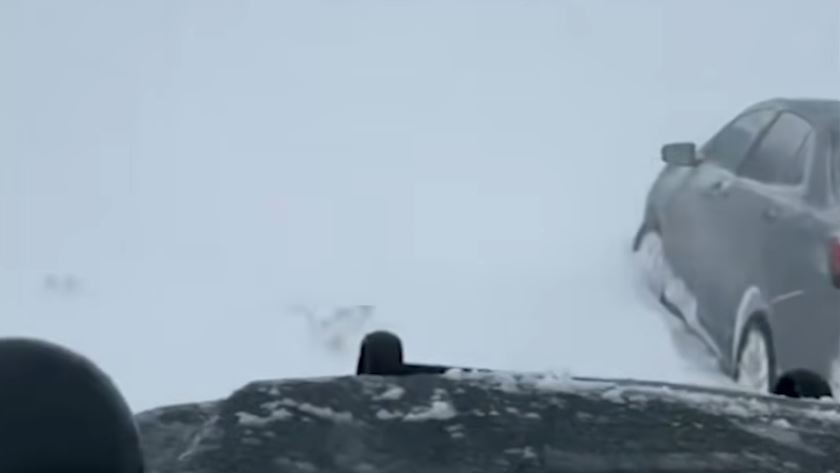
When you drive over Donner Pass during a snowstorm, it seems like you are traveling back in time. Beyond the guardrails, granite peaks rise into cloud cover, chain controls slow traffic to a crawl, and windshield fogs at the edges. Every driver may feel the impact of what transpired here long before Interstate 80 carved out its route through the Sierra Nevada, at least in a subtle way.
Donner Pass isn’t the highest mountain crossing in the American West at 7,056 feet. However, it might be the most emotionally taxing. The pass, named for the tragic Donner Party, still bears the memory of a wagon train that was trapped by early snow in 1846, with only 45 pioneers surviving the winter. Some turned to eating other people. The public has never completely forgotten that detail, which is frequently mentioned in textbooks and documentaries.
| Category | Details |
|---|---|
| Name | Donner Pass |
| Elevation | 7,056 feet (2,151 meters) |
| Location | Nevada County, California, United States |
| Mountain Range | Sierra Nevada |
| Traversed By | California Trail, First Transcontinental Railroad, Lincoln Highway, U.S. Route 40 (historic), Interstate 80 (indirectly) |
| Nearby Landmarks | Donner Lake, Donner Memorial State Park |
| Historical Event | Donner Party winter of 1846–1847 |
| Modern Use | Major highway corridor (I-80), freight rail line, recreation and ski resorts |
| Reference | https://en.wikipedia.org/wiki/Donner_Pass |
It’s difficult to reconcile that history with the serene water’s surface when you’re standing close to Donner Lake on a clear morning. The shoreline is framed by pine trees. Granite slabs are trickled with snowmelt. Unaware—or perhaps subtly aware—of what transpired above them almost two centuries ago, families unload kayaks in the summer. The scenery seems to follow its own wisdom, offering beauty without commentary.
Long after the wagons ceased to exist, the pass became indispensable. In the 1860s, the Central Pacific Railroad carved tunnels and built enormous snow sheds as it blazed through solid granite. Using hand tools and black powder, hundreds of Chinese workers carved the Summit Tunnel through Donner Summit, overcoming what many engineers at the time believed to be insurmountable terrain. It’s difficult not to feel a grudging respect for that audacity when you see freight trains slithering down that same corridor today, steel wheels grinding against tracks laid over merciless rock.
However, nature has never given up completely. Seven people were killed in 1936 when a blizzard trapped over 750 drivers on the pass. Heavy snow immobilized the City of San Francisco passenger train in 1952, leaving it stranded west of the summit for three days. Although those tales don’t seem as legendary as the Donner Party, they do show a trend. Progress is made. Storms break out. The cycle is repeated.
Vulnerability still exists despite advances in avalanche control and forecasting. Traffic from Colfax to the Nevada state line was stopped this winter due to the frequent closures of Interstate 80 over Donner Pass caused by heavy Sierra snow. Visibility was completely lost due to snowfall rates of one to two inches per hour. Reno schools postponed their openings. Early closures were observed by state offices. The extent to which any infrastructure improvement can completely counteract the damage that gale-force winds and brittle snowpack layers can cause in a few hours is still unknown.
This is an example of a cultural paradox. Donner Pass serves as a logistical link between the rest of the nation and the coast of California. Every day, trucks carrying electronics and produce pass through it. Under Mount Judah, freight trains thunder through Tunnel 41, eschewing the previous summit alignment that was abandoned in the 1990s. However, it continues to be a playground for recreation, with ski resorts like Sugar Bowl and Boreal attracting crowds of people looking for powder.
Tension arises from that dual identity—escape and commerce. The pass is seen as infrastructure by investors and transportation planners, who see it as an essential component of supply chains. It is considered wilderness by hikers and skiers, where alpine lakes and wind-carved cornices provide a sense of near-freedom. Both points of view might not be totally accurate. Donner Pass appears to defy easy categorization, declining to be merely a highway or a historical landmark.
Part of the original Donner Camp is preserved at the neighboring Donner Memorial State Park. The height of the Pioneer Monument indicates how deep the snow was during that harsh winter. Quietly, visitors stroll around it, reading plaques and watching kids trace engraved names with gloved fingers. Even on sunny days, there is a sense of solemnity in the air. It’s difficult to ignore how tiny the clearing seems in comparison to the surrounding peaks’ immense size.
Additionally, Donner Pass provides insight into American self-assurance. Driven by rumors and ambition, the California Trail once pushed wagons through this mountain notch. After that came the Lincoln Highway, U.S. Route 40, and finally Interstate 80. Every generation thought it had found a solution to the efficient and safe crossing of the Sierra. Heavy snowfall every winter also serves as a reminder to travelers that fixes are only temporary.
It seems as though history is still being layered as you watch traffic slither forward at a chain control checkpoint, brake lights gleaming red against the snow falling. The instruments have evolved. It feels like the stakes are different. However, the basic negotiating process between people and mountain weather is still going on, silently and unrelentingly.
Attracted by the same slopes that once trapped wagons, backcountry skiers now explore the area around Castle Peak and Donner Summit. Warnings are issued by avalanche forecasters. Rescue workers put in a lot of training. Storms continue to challenge judgment. Professionals and pioneers are treated equally under the pass.
Donner Pass has survived because it is necessary, beautiful, and inevitable. It is the most significant transmontane route that links the interior West with San Francisco. However, it also serves as a reminder that geography has a greater influence on fate than any policy ever could. Granite is not easily yielded. Snow builds up regardless of calendars.
Maybe that’s why Donner Pass is still so fascinating. It is more than a simple crossing. Between valleys, between eras, between hope and prudence, it is a threshold. Additionally, it seems as though the mountains are subtly reminding everyone passing through that progress is conditional every time a storm moves in, blocking lanes and burying road signs.