
Parents all over the world seem to recognize a certain look without having to give it a name. The strange emotional flatness followed by an explosion of feeling, the glazed eyes, the meltdown that occurs the instant a device is taken away. Many may have thought that this was just typical of contemporary childhood—noisy, overstimulated, and difficult to control. According to a study that was published this month in the Psychological Bulletin, a more precise mechanism that has been developing covertly for years may be at play.
Increased screen time in children under ten was consistently linked to what researchers refer to as socioemotional problems, such as anxiety, depression, hyperactivity, and aggression, according to a meta-analysis of 117 longitudinal studies that included data from over 292,000 children worldwide. Not now and then. Not in dire circumstances, as a pattern found in data gathered over decades and across four continents. The term “bidirectional” keeps coming up in the paper, and it’s more important than it might seem.
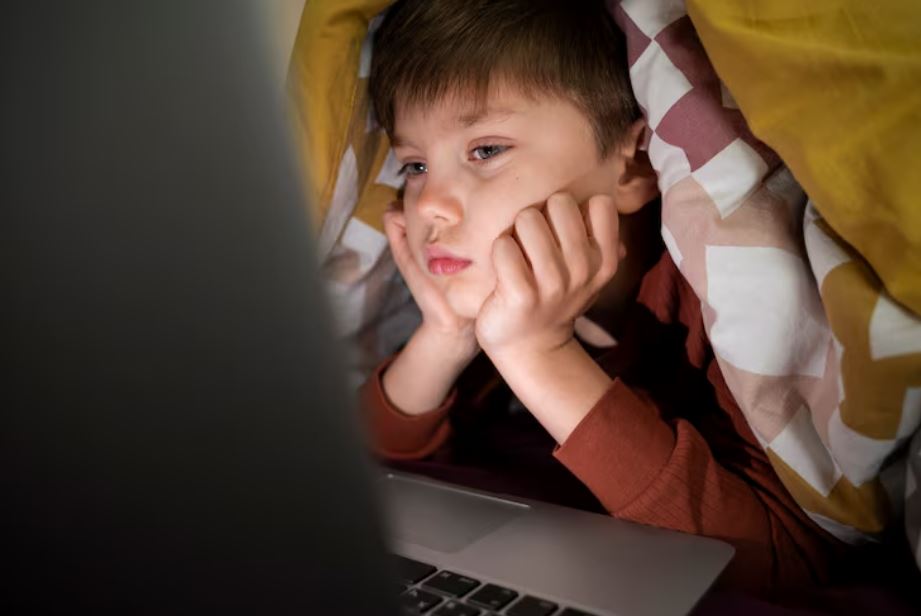
The confirmation that screens are associated with emotional problems—which, to be honest, most parents already sensed—is not what distinguishes this study from the typical screen-time alarm. The researchers discovered this feedback loop. Children who are experiencing emotional difficulties often turn to screens as a coping mechanism, which tends to exacerbate rather than alleviate the initial issue. One of the study’s authors, Michael Noetel, an associate professor at the University of Queensland, put it simply: children who are already having trouble turn to video games as a way to escape, and while that may provide short-term respite, over time it reinforces the very emotional challenges that led them there. From the inside, it’s a cycle that is easy to overlook.
Among the data, gaming stood out as a specific issue. Gaming was linked to a higher risk of socioemotional issues when compared to general recreational or educational screen use. When experiencing emotional distress, boys were more likely to increase their gaming. In the first place, girls were more likely to experience issues as a result of screen time. These are not minor peculiarities in behavior. Over time, researchers have identified these patterns in hundreds of thousands of kids.
The age distribution is worth considering because it challenges the assumptions made by many parents. Compared to children under five, children between the ages of six and ten were more susceptible to emotional effects; in other words, older children are more, not less, at risk. It is time to reconsider the notion that toddlers’ screen habits are the primary battlefield. The data now takes seriously a ten-year-old who uses a device for three hours every day.
The lead author of the study, Roberta Vasconcellos, a lecturer at the University of New South Wales, took care to note its limitations. In 117 different studies, it was not possible to fully control for parenting style, socioeconomic background, and home environment. Additionally, because the study examined screen time in general, it is still more difficult to pinpoint the precise effects of social media, including its algorithms, comparison mechanisms, and unique pull. It’s still worth keeping an eye on that gap.
Reading the results gives the impression that the scale and longitudinal design of this study set it apart from previous screen-time warnings. These surveys weren’t snapshots. Compared to most studies in this field, the evidence is much closer to cause and effect because researchers tracked children over time. It’s not a definitive response. However, it’s also not a recommendation. Children’s emotional lives are being influenced by something that most families consider to be background noise; the question now is whether this realization occurs early enough to be significant.
FAQs
1. What did the study find about screen time and children’s emotions?
Screen time consistently links to anxiety, depression, hyperactivity, and aggression in under-10s.
2. Why is the feedback loop dangerous?
Struggling kids turn to screens for relief, which worsens the emotional problems driving that need.
3. Which type of screen use caused the most harm?
Gaming posed a higher socioemotional risk than recreational or educational screen use.
4. Are younger or older children more at risk?
Children aged six to ten are more emotionally vulnerable to screens than toddlers.
5. How reliable is this research compared to previous studies?
Tracking 292,000 children longitudinally puts it far closer to cause-and-effect than prior snapshots.