
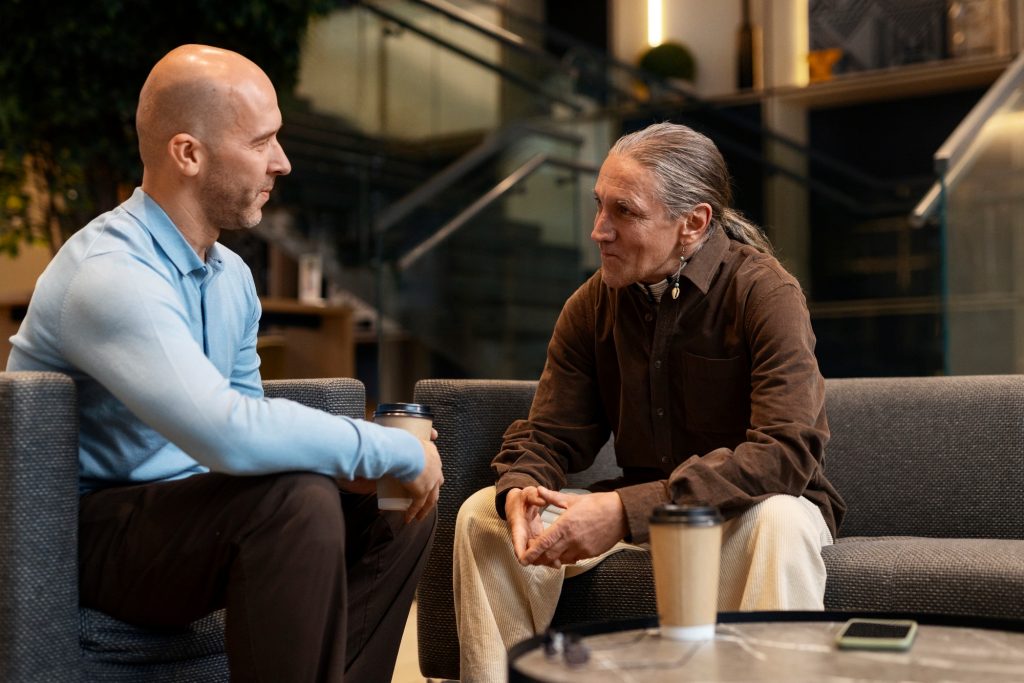
A group of men wearing high-vis jackets file into a small brick building off Deansgate on a soggy Tuesday night in Manchester. They avoid looking at each other. Phones are examined. Hoods remain up. It might appear to be a standard meeting from the outside. It’s group therapy inside.
British masculinity used to look like this.
In the UK, men were taught to get on with it for decades. Not only was the stiff upper lip a folktale, but it was also a practiced policy that was upheld in pubs, workplaces, and schools. However, in 2026, a change occurred. Silently. Reluctantly, almost. More men than ever before are going to therapy, and they’re doing it quietly.
| Category | Details |
|---|---|
| Policy Initiative | Men’s Health Strategy for England |
| Announced By | UK Government |
| Year Introduced | 2025 |
| Focus | Reducing stigma, improving access to care, addressing early male mortality |
| Key Statistic | Around three-quarters of UK suicide deaths are men |
| Reference Website | https://www.gov.uk/government/publications/mens-health-strategy-for-england |
Grim arithmetic is one aspect of this shift. In the UK, suicide is still one of the main causes of death for men under 50. Approximately three-quarters of suicide deaths occur in men, according to data referenced in the government’s Men’s Health Strategy. That figure is difficult to ignore because it lingers in the air like fog. Perhaps a simple realization that silence has been costing lives is the reason for the recent spike in therapy visits.
In late 2025, the first national Men’s Health Strategy for England was released, marking a political recognition that men have long been under-involved in healthcare. Officials talked about “meeting men where they are,” which includes barbershops, workplaces, and sports clubs. The concept seems more practical than groundbreaking. However, there is a perception that something cultural loosens once the government places masculinity on the public health agenda.
At the same time, it is now impossible to conceal the burden on mental health services. According to data from NHS England, millions of people must wait more than eighteen weeks to receive mental health care. According to some estimates, six million in early 2026. People turn to private care out of desperation when waiting lists get that long. Men as well.
Therapists in London’s Canary Wharf report seeing a new type of client: finance professionals in their mid-30s who are exhausted from late-night emails and performance pressure and who have their bedroom ceilings glowing. In Glasgow, tradespeople and electricians talk about back pain combined with an intangible tightness in the chest. Fathers in their forties sit in dimly lit consultation rooms across the nation, attempting to explain why they are constantly angry.

It’s difficult to overlook the fact that a large number of these men do not identify as “depressed.” They claim to be worn out. or agitated. or trapped. The language is useful. Nearly mechanized.
That is also changing, according to therapists. The vocabulary of younger men, especially those in their twenties and early thirties, has been influenced by workplace wellness seminars, Instagram reels, and podcasts. They discuss testosterone levels, cortisol, and burnout. Instead of stifling stress, they talk about controlling it. It seems as though masculinity is being edited in real time as this is happening—not eliminated, but reframed.
Additionally, biology has entered the conversation. Research has given therapy a new context by connecting prolonged stress to increased cortisol and decreased testosterone. It’s not about “opening up” for certain men. It’s about regaining motivation, balancing emotions, and getting a good night’s sleep. Therapy turns into a tool for performance. A gym for the mind.
Skepticism persists, of course. According to surveys, male clients are frequently more skeptical than female clients, at least in the beginning of sessions. Therapy is still seen by some as an admission of failure. Others are concerned about the expense, particularly since private sessions in large cities can cost well over £100 per hour. Whether the NHS can effectively cut wait times enough to maintain this cultural change is still up in the air.
However, there are subtle but telling indicators.
A lunchtime “men’s circle” in a co-working space in Leeds last month sold out in a matter of days after it was promoted. No flamboyant speeches. Only sandwiches, clumsy giggles, and then stories. Online therapy sessions have made it possible for farmers and shift workers in rural Northumberland to log in after dark, with carefully angled cameras, and talk about anxiety in between livestock checks.
Discretion is now easier thanks to technology. With the NHS App, private platforms, and encrypted video calls, therapy can now be scheduled in between gym sessions and school pickup. That is important. The emotional flamboyance of British men is not a recent development. They are incorporating mental health into their daily lives in an almost imperceptible way.

Change may also be influenced by economics. Households can be devastated by prolonged sick leave that drops to Statutory Sick Pay. The cost of presenteeism—when workers are physically present but mentally absent—is becoming apparent to employers. Emotional control appears to be seen as a productivity advantage by both executives and investors. Once viewed as a luxury, therapy is now being reframed as upkeep.
Afterward, there is fatherhood.
In 2026, a lot of men going into therapy talk about their kids rather than themselves. Silence is not something they wish to transmit. They wish for their sons to be able to express their sadness. To see vulnerability without fear in their daughters. Disrupting generational trends has emerged as a potent incentive that may be more convincing than any government initiative.
This doesn’t feel triumphant or loud. It seems cautious. gradually. Actual.
As the session comes to an end on that Tuesday night in Manchester, the men depart in the same manner as they came in: silent, shoulders squared. However, there is a subtle difference. There is less tension now. A couple of numbers are exchanged. One stays to pose a follow-up query to the therapist.
It might not appear to be a revolution. But there’s movement beneath the surface. And that quiet movement may be one of the most significant changes occurring in Britain in 2026.