
Imagine a quiet, dimly lit therapist’s office with a box of tissues on a side table. The patient is asked to follow a moving hand with their eyes while keeping in mind their worst memory, rather than going into detail about it. No extended exposure to words. No manila folder containing homework was sent home. That precise back-and-forth motion, repeated in sets, until the brain starts to change. On the surface, it seems like something created during a weekend wellness retreat. That’s how the scientific establishment treated it for years.
Most likely, that era is over. More than thirty published randomized controlled trials have shown the efficacy of Eye Movement Desensitization and Reprocessing (EMDR) in treating PTSD in both adults and children. It is advised as a first-line treatment by the World Health Organization. The International Society for Traumatic Stress Studies, the U.S. Department of Veterans Affairs, and the National Institute for Health and Care Excellence in the United Kingdom all do the same. That’s an incredible institutional journey for a therapy that began in 1987 when a psychologist noticed that her own troubling thoughts seemed to subside while taking a stroll in a park in California.
In 1989, Francine Shapiro published her first controlled study in which she used a single session of what she called Eye Movement Desensitization to treat 22 patients who had experienced physical assault, sexual abuse as children, and combat in Vietnam. At a three-month follow-up, the gains persisted. Critics attacked right away. The therapy was personally administered and scored by Shapiro, the sample size was small, and the entire process felt unsettlingly speculative. The optics were negatively impacted by her decision to trademark the method and mandate paid certified training before practitioners could use the name. There is a feeling that the weight of the accumulated evidence is only now beginning to erase the residue left by those early disputes.
EMDR differs structurally from most trauma therapies not only in the eye movements but also in what the patient is not asked to do. There are no written exposure exercises, no prolonged verbal recounting of the incident, and no structured dialogue challenging beliefs. From the first history-taking to the desensitization and body scan to the re-evaluation in subsequent sessions, the therapy is divided into eight phases. However, the actual processing takes place with comparatively little speech. That design decision makes the therapy accessible in a way that standard cognitive behavioral approaches occasionally aren’t for patients who find it impossible to describe their trauma without feeling overwhelmed—a genuinely common barrier. Only 3% of high-risk patients who received EMDR experienced PTSD symptoms three months later, compared to 19% of the control group, according to a 2018 study published in emergency medicine. It is not a marginal result.
The main scientific objection to EMDR has never been that patients don’t get better—in fact, they do, and quite consistently. The claim is that the eye movements in particular might not be to blame. Dismantling studies have compared versions of EMDR with and without bilateral stimulation, sometimes observing minimal differences in results. The phrase “purple hat therapy” was created by critics, including psychologist Scott Lilienfeld, to describe this exact situation: a therapist wearing a purple hat during cognitive behavioral therapy (CBT) may give credit to the hat, but CBT remains the active component. It’s possible that structured trauma exposure, disguised as something more bearable, is the true mechanism behind EMDR. That is a sincere inquiry about what is truly taking place within the treatment, not a rejection of it.
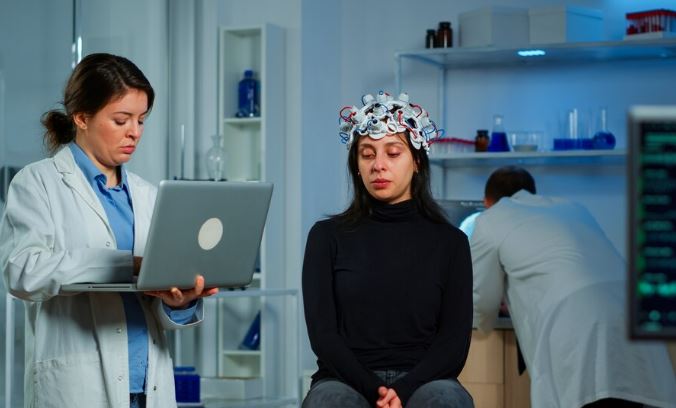
However, that criticism has begun to be complicated by neurobiological research. Following EMDR, brain scan studies reveal quantifiable structural changes that do not occur in control groups, such as increased grey matter volume in specific areas and altered connectivity between the temporal pole and prefrontal cortex. According to one theory, bilateral stimulation weakens the emotional charge of the memory each time it is retrieved by taxing working memory during recall. Another suggests parallels with the neural activity of REM sleep, in which the brain processes emotional experiences on its own at night. There is no complete proof for either theory. However, there is more evidence now than there was fifteen years ago that something particular and neurological is occurring during EMDR.
It’s difficult to ignore how much the discussion has always focused on topics other than therapy itself as you watch this field progress—slowly, contentiously, through layers of institutional skepticism. EMDR had an origin story that deviated from the standard model of laboratory-born science, arrived before its evidence base was strong, and was commercially packaged before rigorous trials were finished. It’s still unclear if that history will completely loosen its hold on how some people view the treatment. However, the fact that the therapy is ineffective seems harder and harder to dispute. There are trials. There are the endorsements. Some patients get better in fewer sessions than what CBT calls for. Nowadays, the main point of contention is mechanism, and it is not particularly unusual in medicine for a treatment to be successful before its mechanism is fully understood.