
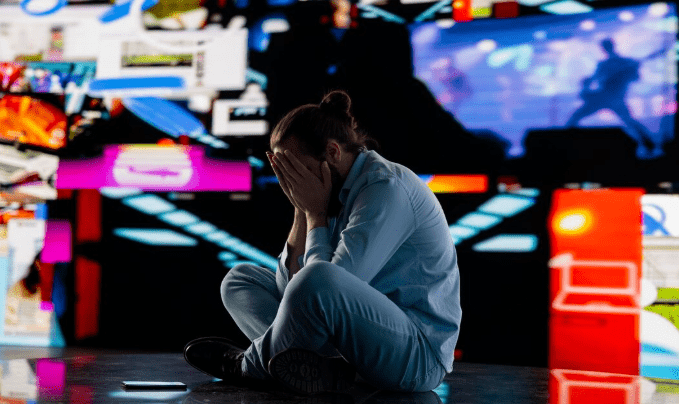
Many people have been feeling a certain kind of tiredness lately. It’s more akin to a bone-level heaviness that develops after watching videos of missile strikes and burning cities before breakfast than the fatigue that results from working too late or getting too little sleep. It was initially observed in the therapy rooms of Dr. Ahona Guha, a Melbourne-based clinical and forensic psychologist. She writes that since the attack on Iran by the US and Israel, her sessions have been overrun with clients who describe a world that has changed irrevocably and who are unsure about even the most basic decisions, like whether to replace a piece of furniture or book a vacation. They don’t have a dramatic personality. They are regular people reacting to an extraordinary and unrelenting stream of information about things that are beyond their control.
Although most people who are experiencing it wouldn’t think to use it, what’s happening to them has a name. Vicarious trauma, also known as secondary trauma, is the result of people who weren’t directly involved experiencing stress when they are repeatedly exposed to the suffering of others. According to Professor Susan Rees of the University of New South Wales, who has studied trauma-affected populations for years, trauma is defined by the American Psychiatric Association as experiencing or witnessing extreme stress that exceeds a person’s ability to cope. The crucial term in that context is “witnessing.” Because in 2026, one does not need to be in proximity to a war to witness it. All you need is a signal and a phone.
Key Information
| Topic | Psychological impact of Iran war news coverage on global audiences |
| Key condition discussed | Vicarious trauma, atrocity fatigue, compassion fatigue, existential anxiety |
| Key expert (psychiatry) | Prof. Susan Rees — University of New South Wales, psychiatry & mental health |
| Key expert (journalism) | Ayesha Jehangir — UNSW; coined the term “atrocity fatigue” for repeated conflict exposure |
| Key expert (trauma therapy) | Dr. Ahona Guha — clinical & forensic psychologist, Melbourne; author on complex trauma |
| Reuters Digital Report (2025) | News avoidance rising globally — top reason: negative effect on mood from conflict coverage |
| Documented symptoms | Anxiety, sleep disturbances, intrusive imagery, panic disorder, heightened threat perception |
| Iran internal trauma scale | Tens of thousands killed; mass arrests, communications blackouts, diaspora trauma documented |
| Social media factor | Unfiltered live footage bypasses editorial safeguards — accelerating vicarious trauma |
| Expert recommendation | Limit to one news source daily; avoid compulsive checking; name the anxiety as existential |
| Reference / Source | The Guardian — War anxiety in therapy rooms (Mar 2026) |
Rees lists several specific and clinical symptoms, including panic disorder, anxiety, sleep disturbances, intrusive imagery, and a persistently elevated sense of threat. She found quantifiable increases in panic disorder symptoms among Australian women with cultural or familial ties to the affected region during the 2023–2025 Middle East conflict, but she is certain that the effect is not exclusive to those with personal ties. It was demonstrated by the September 11 studies. It was confirmed by research on the Boston Marathon bombing. The psychological effects of graphic, frequent coverage of widespread harm extend well beyond those directly affected by the events.
This has been significantly worsened by social media, most likely in ways that would have shocked researchers even ten years ago. Alexandra Wake, an RMIT University journalism professor who specializes in trauma-informed reporting, distinguishes between the raw, unfiltered streams that now predominate in how people actually consume news and traditional broadcast journalism, which usually removes the most graphic imagery. She notes that anyone with a phone can broadcast straight from a conflict zone since live streaming became commonplace.
No editorial filter or determination of what a viewer can reasonably absorb has been applied to the footage that appears on your screen. You may be enjoying dinner in your kitchen in Manchester or Karachi when all of a sudden you see something that belongs in a war crimes tribunal. Putting down the phone does not bridge the gap between those two realities.
The phrase “atrocity fatigue” refers to what occurs over time, according to Ayesha Jehangir, a lecturer in journalism and communication at the University of New South Wales. The mechanism is almost counterintuitive: people are not always more distressed when they are repeatedly exposed to shocking imagery. Their ability to feel anything at all gradually decreases. The pictures are fuzzy. The names cease to register. In the social media age, where the volume and frequency of violent imagery are unprecedented, what Susan Sontag discovered decades ago—that repeated exposure to suffering dulls the initial shock—has accelerated into something more acute. The cruel irony is that many people become less capable of processing the Iran war in a meaningful way as they learn more about it.
The psychological harm is occurring on a completely different scale within Iran. In an article for Fair Observer, Dr. Bahareh Sahebi describes a population showing symptoms of what she refers to as collective nervous-system collapse: people sleeping in bits and pieces, waking up at tiny noises, and rapidly alternating between anger and numbness. This isn’t a metaphor. It’s physiological. The body reacts as it is meant to when violence becomes the norm: it remains constantly alert to danger. Iran’s people came to this crisis with decades of accumulated trauma, including a revolution, a bloody war with Iraq, ongoing sanctions, and numerous protest movements that were met with gunfire and incarceration. For many Iranians, January 2026 did not feel exceptional. It seemed to be confirmation of a pattern they had always anticipated would recur.
This is carried in a different way by the diaspora overseas. Iranian communities in Europe, North America, and Australia have been observing from a distance that provides no real defense against the psychological effects, feeling what Sahebi refers to as survivor’s guilt colliding with moral urgency. Many believe that pausing, even for a moment, to rest or turn away, is a form of betrayal. Because the cause of that specific type of distress is real and ongoing rather than a cognitive distortion that needs to be reframed, it is nearly impossible to treat in the traditional sense.
There isn’t a clear solution to this problem. Because treating anxiety as a personal disorder rather than a logical reaction to a disordered world only adds a layer of shame to an already heavy burden, experts advise limiting news consumption to a single reliable source, avoiding the temptation to compulsively check, and labeling the anxiety as existential rather than clinical. Considering what people are consuming on a daily basis, it’s still unclear if those suggestions are sufficient. It appears certain that the psychological toll of this conflict goes well beyond the boundaries of the Middle East, quietly finding its way into living rooms, therapy rooms, and the thoughts of those who have only ever observed from a distance.