
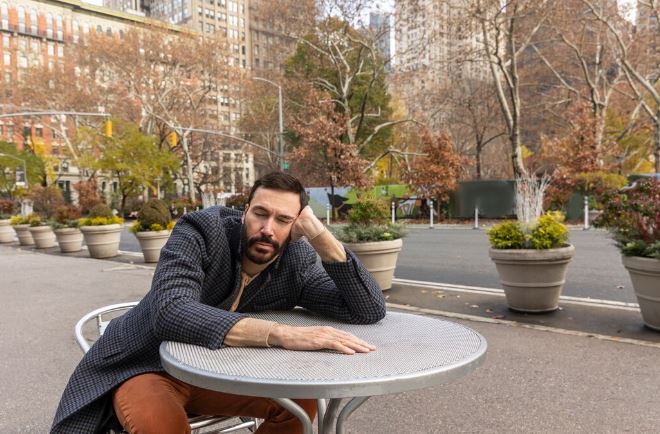
When you spend enough time with a stranger in a waiting area, the moment will come when you both purposefully stare at something other than each other in a hovering, slightly tense silence. Eventually, someone will say something. It’s not because there’s anything worth saying, but rather because the awkwardness of forced conversation has been eclipsed by the silence inexplicably. That little, well-known scene reveals something important about our evolving selves.
In practically every significant way, silence has become an escape. Before the train doors close, commuters fill their earbuds. In vacant rooms, people in apartments leave their televisions on for company. There are dozens of unlisted episodes in podcast queues, a backlog of noise that is ready to take over at any quiet moment. To some extent, this may have always been the case because people have always gathered in boisterous marketplaces, told stories around fires, and played music in their homes. But now, there’s a qualitatively different aspect. It’s now reflexive to fill in, consistent, and nearly uncontrollable.
| Category | Details |
|---|---|
| Topic | The Psychology and Cultural Phenomenon of Discomfort with Silence |
| Core Concept | Modern overstimulation has conditioned brains to interpret silence as threat, rejection, or emptiness |
| Related Fields | Psychology, Neuroscience, Linguistics, Cultural Studies, Mindfulness |
| Key Researchers Referenced | Dr. Deborah Tannen (Georgetown University), Namkje Koudenburg (University of Groningen), Donal Carbaugh (University of Massachusetts) |
| Cultural Context | Anglo-American discomfort vs. Japanese/Finnish comfort with silence; digital age noise saturation |
| Notable Concept | Japanese concept of ma (間) — the meaningful pause; Japanese haragei (belly talk) |
| Key Finding | Research shows discomfort begins at 4 seconds of silence in Dutch/English speakers; Japanese professionals tolerate up to 8.2 seconds |
| Physical Effects of Silence | Lowers blood pressure, reduces stress hormones, supports memory consolidation |
| Relevant Works | John Cage, Silence (1961); Erling Kagge, Silence, in the Age of Noise (2017) |
| Reference Website | Psychology Today — Why Silence Makes Us So Uncomfortable |
Most people, especially English speakers, start to feel uneasy when a conversational pause lasts longer than four seconds, according to research from the University of Groningen. Four seconds. That is hardly enough time to come up with a thoughtful idea, much less present one. However, something changes at that point. The silence begins to seem to indicate something, perhaps rejection, disapproval, or the first indication that the exchange is not working. In contrast, Japanese business professionals are at ease with pauses lasting eight seconds or more. This is because they operate within a cultural framework that views pausing before responding as a sign of respect and seriousness rather than awkwardness. The difference between these two thresholds reveals more about how various societies define silence than it does about silence per se.
According to Dr. Deborah Tannen, a linguistics professor at Georgetown University, the Anglo-American discomfort with silence probably stems from the social history of diverse, immigrant-built communities where verbal communication was the main means of fostering understanding between strangers. When mutual understanding cannot be assumed, communication is used to create it. Over many generations, that habit solidified into something that now appears to be almost neurological. The nervous system seems to have discovered that quiet equals danger and noise equals connection at some point.
Although the phone did not cause this anxiety, it has industrialized it. The slight discomfort of an empty moment, which was once a manageable social quirk, has been given a tool that is perfectly designed to address it before it is even fully felt. It’s not just a habit to feel the need to check your phone whenever you have a moment to spare. It is more akin to avoidance. When given the option of giving themselves a mild electric shock or sitting by themselves with their thoughts for fifteen minutes, a sizable percentage of participants in a 2014 study opted for the shock. It turns out that the absence of stimulation can cause the mind to feel more unpleasant than minor physical discomfort. Even though no one put it quite so bluntly, the app economy has intuitively understood that startling conclusion.
When silence is given time to settle, it actually reveals whatever was hiding beneath the commotion. Unresolved thoughts come to the surface. Unprocessed memories come back uninvited. There’s no podcast to drown out the thing you’ve been half-considering for weeks, nor is there a scroll to break the inner monologue. In general, this explains why silence is unsettling—not because it poses a threat per se, but rather because it eliminates the buffer. Because the brain is used to constant input, it perceives the lack of stimulation as an alarm rather than a state of rest. Something is lacking. The quiet needs to be broken.
It’s difficult to ignore the fact that this unease is especially noticeable in social situations where silence carries the extra burden of interpretation. Pauses in conversation are rarely perceived as neutral. It is interpreted as disagreement, disinterest, or disapproval, sometimes accurately and frequently incorrectly. In her essay on the nature of awkward silences, philosopher Rebecca Roache compares conversations to coordinated dances, where both parties experience a failure when the rhythm is disturbed. In that situation, silence feels like something is wrong rather than like nothing is happening. The type of research that validates what most people already sense in the moment—that silence, in the wrong context, reads as exclusion—supports the sociologist’s observation that people feel something akin to rejection when conversation flow breaks.
However, there is a completely different tradition that coexists peacefully with all of this and views silence as something to pursue rather than run from. The idea of ma, which is loosely translated as “the meaningful pause, the space between,” is interpreted as presence rather than emptiness in Japanese aesthetics. The long shot of wind blowing through tall grass before a character speaks in a Hayao Miyazaki movie is not filler. It is the film’s breathing room. After visiting a Harvard anechoic chamber, expecting to hear nothing, composer John Cage discovered the sound of his own nervous system and blood circulation. He concluded that there is no such thing as absolute silence, only the absence of noise that we have chosen to focus on. Since then, neuroscience has validated what contemplative traditions intuitively understood: brief periods of silence lower blood pressure, slow heart rate, and provide the brain with the consolidation time it needs to create memory and meaning from experience.
All of this doesn’t have particularly dramatic practical implications. A monastery is not necessary. A stroll without headphones. Ten minutes in the morning without a phone. a minute in a parked vehicle before entering. At first, the discomfort is genuine, but with practice, it transforms from a threat to something more subdued and beneficial. Once you’ve sat in it a few times, the silence doesn’t fill itself with dread as consistently. Instead, the kind of low-level clarity that the continuous noise was, possibly, always keeping just out of reach, tends to surface.
Observing how completely contemporary life has structured itself around avoiding silence gives one the impression that something valuable is gradually being lost. Silence is the state that allows for real thought and self-awareness, not deprivation or absence. There is no end in sight to the noise. However, it seems worthwhile to consider what is lost in all that filling.