
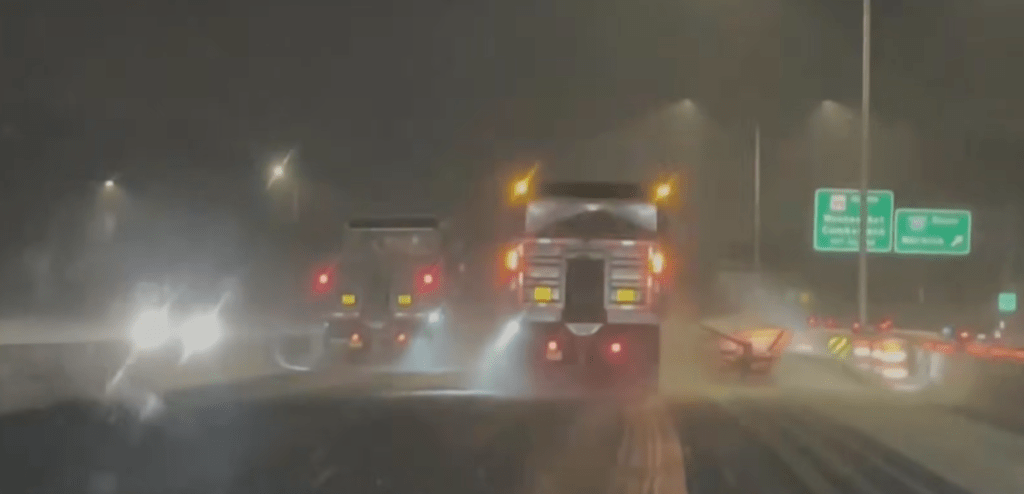
By 6:45 p.m., Providence had that strange, anticipatory quiet that only comes before something large and unwelcome. The sidewalks were already slick. The red glow was being blurred into a halo by the sideways snowfall that was needling against the traffic lights. Additionally, the Rhode Island travel ban went into effect at 7 p.m.
Dan McKee issued the order after announcing a state of emergency in anticipation of what forecasters called a potentially historic blizzard. Forecasters predicted about 21 inches of snow in Providence alone, with high-end projections approaching 35. To put things in perspective, the city received 28.6 inches of snow during the Blizzard of ’78, and the memory of that storm is still ingrained in the locals like a family heirloom.
| Item | Details |
|---|---|
| State | Rhode Island |
| Governor | Dan McKee |
| Order Issued | State of Emergency & Statewide Travel Ban |
| Commercial Vehicle Ban | Began at 5:00 p.m. |
| All Vehicle Travel Ban | Began at 7:00 p.m. |
| Forecast Snowfall (Providence estimate) | 21 inches predicted; higher-end estimates up to 35 inches |
| Enforcement | $85 fine first offense; second violation arrestable |
| Official Reference | https://governor.ri.gov/executive-orders |
Comparisons to 1978 may be as much psychological as they are meteorological. The tone instantly changes from one of inconvenience to one of survival when that storm is invoked. It seems as though Rhode Islanders were preparing for a test of their memory and strength as well as snowfall as they watched the forecast maps fill with dark purple bands.
The actual ban was staged. Beginning at 5 p.m., commercial vehicles were not allowed to travel throughout the state; at 7 p.m., all vehicles were prohibited from traveling. The reasoning was straightforward: clear the roads before the worst weather arrives. However, habit rarely outperforms logic. Traffic cameras along Interstate 95 and the Henderson Bridge continued to display headlights crawling forward within fifteen minutes of the ban going into effect, either in defiance or possibly due to a lack of knowledge.
According to early morning counts, state police responded to 45 disabled vehicles during the course of the night. The snow, the kind that sticks to branches and pulls them down across lanes, had piled up quickly and heavily. “Driving is extremely dangerous,” a public official cautioned. It sounded nothing like a reprimand. It sounded worn out.
There is a silent escalation associated with the penalty structure. a fine of $85 for the first offense. An arrest is made for a second infraction. That is law enforcement drawing a line in blowing snow, not a rhetorical flourish. Perhaps assuming the state line didn’t have the same weight as a barricade, troopers observed that some offenders were essential workers and others were tractor-trailers crossing from Connecticut. It’s still unclear if enforcement primarily acts as a visible reminder that the order is in place or if fines alone alter behavior during storms this severe.
A statewide travel ban feels almost personal because Rhode Island is a small state. There are only so many highways, only so many bridges. Under drifting snow, the Jamestown-Verrazzano Bridge, which is typically bustling with commuters from the other side of the bay, appeared empty. There were faint tire tracks on Route 4 close to Division Street, but they soon vanished under new debris. It’s difficult to ignore how quickly modern life can come to a halt when the weather demands it, when you watch those photos unfold in almost real time.
The period between 4 a.m. and noon was predicted to see the most snowfall. Meteorologists warned that during that window, there would be whiteout conditions that could virtually eliminate visibility. Companies closed early. Late-afternoon sales of canned soup and bottled water were observed in grocery stores. Before a storm, there’s always that silent preparation—stocking up, texting neighbors, checking flashlights twice—half precaution, half ritual.
Perhaps the complexity of the response is what makes this moment feel unique. The Rhode Island National Guard was activated by the governor’s proclamation. When the situation became safe for restoration, troopers were ready to escort Rhode Island Energy trucks in addition to issuing tickets to drivers. Crews cannot be raised 40 or 50 feet into the air by bucket trucks in strong winds. When downed lines begin piling up, that little operational detail—crews grounded by gusts—has huge ramifications.
Every winter emergency in New England raises a larger question: are expectations just rising, or are these storms becoming more disruptive? It appears that investors think infrastructure can manage nearly anything. Residents, meanwhile, seem to believe they can too—until they can’t. There is a stubbornness that seems particularly regional when you see traffic continuing to move forward despite a declared ban.
However, many highways had calmed down by dawn. In deliberate passes, snowplows pushed thick ridges in the direction of guardrails. Less-traveled secondary roads appeared to be swallowed. And gradually, curiosity gave way to compliance.
A travel ban is more than just a regulation. It is a shared understanding that movement gives way to safety for a few hours or a day. Compact and coastal, Rhode Island is aware of how vulnerable its roads are to the combination of wind and snow. The directive to remain at home aims to avoid rescue calls in the first place as much as to make room for emergency personnel.
It remains to be seen if this storm will eventually become as legendary as 1978. Standing beneath a streetlamp with snow sweeping sideways, it seems certain that the ban itself is a serious moment. “Not tonight,” it says. Not now.
And occasionally, that self-control is what prevents a storm from getting worse.