
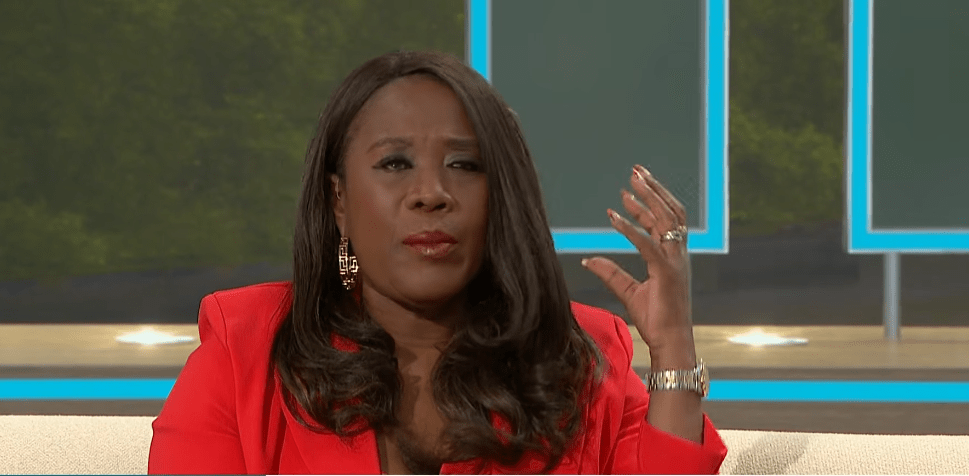
Credit: Good Morning Britain
Tessa Sanderson recently talked about a moment on Good Morning Britain that really resonated with me because of its subtle honesty rather than its drama. She claimed that when she saw others wearing hearing aids, she would firmly tell herself, “That won’t be me.” In the hopes that no one would notice, she would pretend to read lips, follow conversations, and smile at the appropriate times while sitting in rooms. A small piece of plastic worn behind the ear embarrassed a woman who had stood by herself in front of the entire world in an Olympic stadium, javelin in hand. That paradox demonstrates how even the most illustrious lives have aspects of personal struggle.
According to her own account, Sanderson celebrated her 70th birthday in style in March. She flew economy to Morocco with twenty of her closest friends, endured a two-hour delay, and apparently received a single honey wheat biscuit from British Airways as compensation. Her online account of it had the distinct tone of someone who has earned the right to publicly and amusingly lament minor injustices. It also sounded like someone who is doing pretty well by most standards.
Tessa Sanderson CBE
| Full name | Theresa Ione Sanderson |
| Born | 14 March 1956, St Elizabeth, Jamaica (age 70) |
| Nationality | British |
| Spouse | Densign White (m. 2010) |
| Sport | Athletics — Javelin throw |
| Olympic appearances | Six (1976 – 1996) |
| Olympic gold | 1984 Los Angeles — Javelin throw |
| Commonwealth golds | 1978 (Edmonton), 1986 (Edinburgh), 1990 (Auckland) |
| Personal best | 73.58 m (1983) |
| Honours | MBE (1985), OBE (1998), CBE (2004) |
| Foundation | Tessa Sanderson Foundation and Academy (est. 2009) |
You must return to a Wednesfield school in the early 1970s to comprehend why Tessa Sanderson matters, and she does matter more than British sports culture has ever acknowledged. Barbara Richards, a physical education teacher, saw something in a teenage girl who had come from Jamaica at the age of six, leaving behind her island, her grandmother, and the security that comes with childhood. Sanderson claims that Richards threatened to put her in after-school detention if she didn’t train. It was a strange kind of support. It was successful. Sanderson threw a javelin for the first time at the age of 14. The winner would receive a bag of chips. She prevailed. She continued to prevail.
She was the youngest javelin competitor at the 1976 Summer Olympics in Montreal, where she was just 20 years old. She came in ninth. While most athletes her age were still figuring things out at the club level, she was also setting national records and being selected for the senior team, so context is important. Sanderson’s early career had a kind of quiet momentum, with each year bringing in a new record, a final, and a trip to another nation while holding a javelin. She claimed that she picked the event in part because she believed it would advance her. In that regard, the plan was more successful than she could have imagined.
After years of injuries, including ruptured Achilles tendons, a broken bone in her throwing arm, successful surgery, and a 22-month absence from competition, she was able to compete in the 1984 Summer Olympics in Los Angeles. In 1983, she returned with one of the longest throws ever made by a woman, measuring 73.58 meters. Then, when it counted most in Los Angeles, she won gold with a throw of 69.56 meters. It set an Olympic record. Since the modern Games started in 1896, it was Great Britain’s first Olympic victory in a throwing competition. Additionally, Tessa Sanderson became the first Black British woman to win an Olympic gold medal on that day. This is a fact that should be stated clearly and unapologetically because it is still not discussed enough.
Throughout nearly all of this, the rivalry with Fatima Whitbread operated as a supporting plot and was, according to most accounts, genuinely fierce. It was described as one of the most “splendid” feuds in British sport by journalists at the time; this word choice likely says more about how the media portrayed women’s athletics than it does about the women. The information that has surfaced over time points to something less glamorous: salary differences, alleged partiality on the part of athletic administrators, and the unique unease of two talented individuals competing not only against one another but also against a system that found it difficult to treat them equally.
According to the record books, Sanderson prevailed in 27 of their 45 head-to-head encounters. However, during the years when both were at their height, Whitbread received a significantly larger financial reward thanks to her management connections. That was understandably upsetting. Sanderson told the Telegraph in 2019 that she had developed a new perspective on the rivalry, seeing it as something that challenged her beyond what comfort could have. She remarked, “It drove me to another level.” That kind of reflective serenity is either a sign of real development or a very disciplined public persona. Maybe both.
The length of Sanderson’s relevance may be underestimated. Twenty years and six Olympic Games. three gold medals from the Commonwealth. At the time she set a personal record, it was still one of the longest throws in women’s history. At forty, she was competing in the javelin, breaking masters records, and earning a spot in the 1996 Summer Olympics in Atlanta. Most athletes reach their peak and then decline. With the kind of tenacity that doesn’t make for easy headlines but makes for an incredible career, Sanderson simply continued to show up, injured or not, favored or not.
She also constructed something outside the stadium. a base. A Newham academy that assisted in selecting athletes for the 2012 Olympics. Every year, an Olympic park hosts races. a position at Sport England as vice-chair. She appeared on television, co-hosted shows, and covered the 1989 launch of Sky News. This was not an accident. It occurred because Sanderson appears to be incapable of stopping completely, which is either a positive trait or an indication of how competitive sports affect a person’s ability to remain motionless. It’s difficult to say which.
The most recent and, in some respects, most instructive part of her story is about hearing loss. She compensated in rooms for years, bluffing her way through conversations that had partially devolved into silence, missing words during speeches and after-dinner conversations. It’s not uncommon to feel that particular, acute embarrassment regarding a medical aid. Due to the perceived high social cost of the visible device, millions of people suffer from untreated hearing loss. It requires a different kind of nerve than throwing a javelin, but Sanderson has decided to say that aloud. Being publicly excellent is, in a sense, easier than being publicly flawed. Now, at seventy, she’s taking on the more difficult task of supporting a campaign to change public perceptions of hearing aids. It is more important than the majority of sports campaigns.
Tessa Sanderson’s continued presence in the conversation, whether it be on morning television, posting from her phone, or arguing with British Airways over biscuits, seems appropriate. She has outlived the time period that occasionally did not give her due credit. The documents are present. The medals are present. She is now arguing that vulnerability isn’t the antithesis of strength with a directness that seems to have followed her from Wednesfield to Los Angeles to wherever she is now. She has demonstrated for fifty years that she was already aware of that. Now she’s saying it correctly.