

Teenagers scroll through filtered lives, product advertisements, and brief videos in the late-night blue glow of a bedroom illuminated solely by a phone screen. Almost instinctively, the thumb moves. A notification appears. One more swipe. Another jolt of something minor but pressing.
It’s difficult to ignore how little thought goes into those situations.
The current research question seems surprisingly straightforward: Is social media exposing or causing impulsive behavior? According to recent research, the response might be unsettling. General impulsivity and problematic social media use were consistently found to be positively correlated in a 2025 meta-analysis of Problematic Social Network Sites Use (PSNSU). Although not very strong, the association was statistically significant. That is important.
| Category | Details |
|---|---|
| Key Topic | Social media use and impulsive behaviour |
| Major Concept | Problematic Social Network Sites Use (PSNSU) |
| Core Psychological Factor | Impulsivity (general and multidimensional) |
| Neurological Focus | Dopamine reward pathways, prefrontal cortex |
| Notable Framework | I-PACE Model of Addictive Behaviours |
| Estimated Users (2025) | 5.24 billion global social media users |
| Reference | https://pmc.ncbi.nlm.nih.gov/articles/PMC12165459 |
Global usage data shows that the average person now spends over two hours a day on social media. It’s not a neutral time. Platforms are built around sporadic rewards that are given in an unpredictable manner, such as likes, comments, and shares. Unpredictable rewards have long been recognized by neuroscientists researching dopaminergic pathways as being especially potent in activating the nucleus accumbens and reinforcing behavior. That system wasn’t created by social media. It just made it more industrial.
It’s typical to see students half-eating, half-scrolling, and laughing at a video while ignoring the person at the other table when you walk through the cafeteria on a university campus. Discussions are broken up. Focus strays. Particularly among younger users, there seems to be a decline in prolonged focus. Excessive digital use has been associated in studies cited in PubMed Central with increased impulsivity and attention problems, especially in teenagers whose prefrontal cortex, the brain’s braking system, is still maturing.
It’s possible that impulsivity is not a spontaneous result of social media use. However, it might intensify innate tendencies.
Impulsivity was divided into four categories by the 2025 meta-analysis: motor impulsivity, attentional impulsivity, lack of perseverance, and lack of premeditation. Curiously, one of the strongest correlations with problematic use was found to be a lack of perseverance, or the inability to stick with tasks.

That seems natural. Short-form content encourages users to switch from one stimulus to another in a matter of seconds by rewarding rapid attentional shifts. The switching behavior might eventually become the norm.
This pattern is not limited to scrolling. Both active and passive use of social media were linked to emotional reactions, including depression and enjoyment, which in turn affected impulsive purchases, according to research published in Frontiers in Psychology. In one study of Chinese college students, impulsive purchases were associated with both depression and enjoyment, and passive browsing exacerbated depressive symptoms. Positive or negative emotional upswings appear to reduce the threshold for making snap decisions.
Retailers are aware of this. Emotional immediacy is the foundation of influencer marketing and algorithmic targeting, which present products to consumers just when they’re bored, nervous, or excited. It seems that investors in social commerce platforms think that frictionless design, such as one-click purchasing and time-limited promotions, turns emotional arousal into income. Users’ understanding of how intricately designed these systems are is still lacking.
Additionally, there is a biological layer. Long linked to substance abuse, the mesolimbic dopamine system reacts to cues that predict rewards. Notifications serve as these cues. Micro-surges of anticipation are triggered by each vibration, which implies possible social validation. This cycle may eventually resemble other behavioral addictions, especially if users find it difficult to control their screen time despite the consequences.
Adolescents’ prefrontal cortex, which governs impulse control and long-term planning, is especially susceptible. According to research, dopamine dysregulation may make it more difficult to avoid digital distractions, particularly in disorders like ADHD. Resisting becomes more difficult rather than easier in digital environments designed for instant gratification.
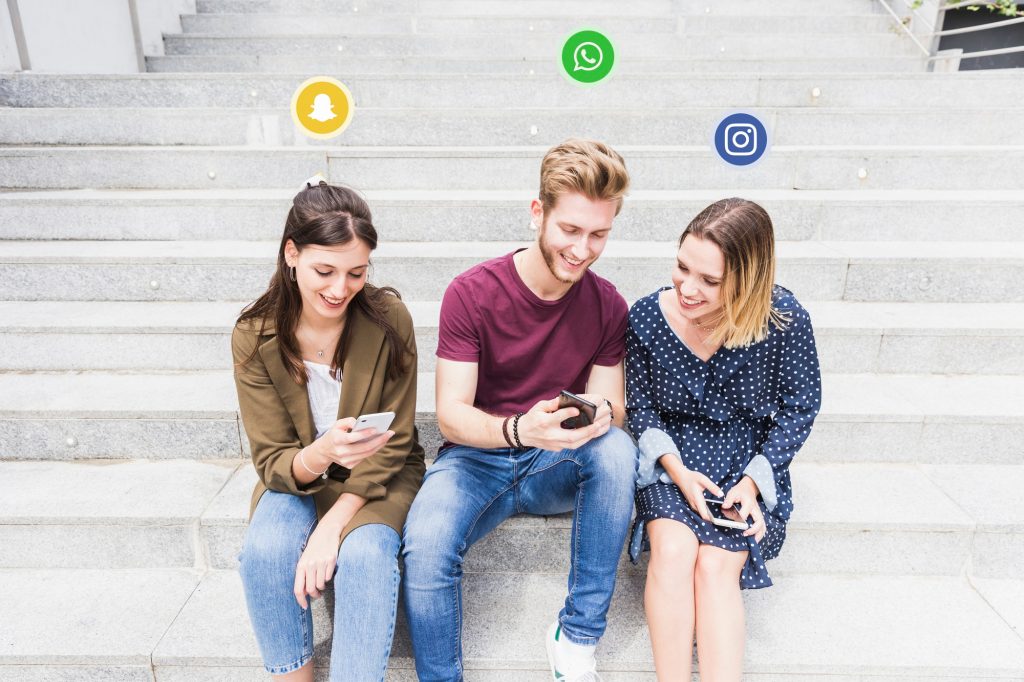
However, prudence is necessary. Not all excessive use of social media is harmful. According to some researchers, losing control is more important than the amount of time spent online. Hours can be spent on social media without causing symptoms of addiction. Others might scroll less, but when they do, they can’t seem to stop.
During rush hour, almost all of the people in the subway car are looking down at a glowing rectangle. Some people are reading with consideration. Others are rapidly switching between clips. As we watch this happen, it seems like we’re all teaching ourselves to be impatient and to act without thinking.
The picture isn’t totally depressing, though. Social media can offer creative outlets, support networks, and connections. Online communication can occasionally feel safer and easier for people with autism spectrum disorders or social anxiety than in-person interactions. Peer support groups and therapy resources can be found on the same websites that are linked to impulsivity.
The design is the source of the tension. The goal of algorithms is engagement, not self-control. Users are kept coming back by variable reward schedules, which are akin to those found in gambling machines. These systems favor fast responses over deliberate thought, whether on purpose or by accident.
It’s easy to paint this as a lack of discipline or a moral failing. However, the science points to a more structural solution. Even minor changes in impulsive behavior could have a significant impact on billions of people who are exposed to environments designed for instant gratification on a daily basis.
Is impulsive behavior on the rise due to social media? Evidence points to a moderate but significant correlation, particularly when use turns into an emotional and compulsive behavior. Platform design, regulation, and digital literacy may have a greater influence on whether this trend picks up steam than personal resolve.
The scroll goes on for now. Alerts illuminate. In a matter of seconds, purchases are made. Additionally, impulse and reflection subtly compete somewhere in the space between the swipe and the click.