
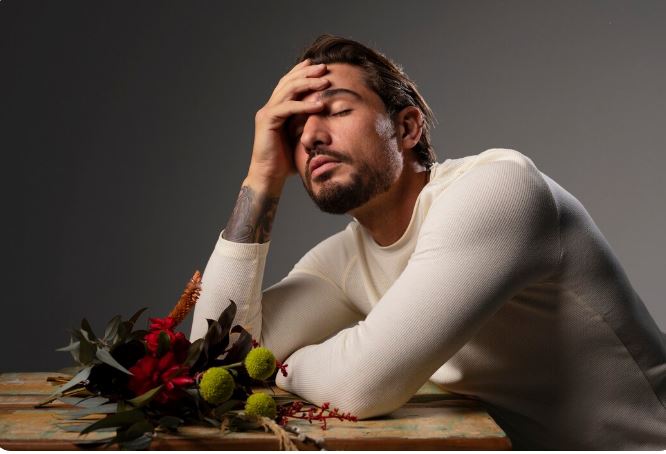
A sixty-year-old man who grew up in a small rural town where stoicism was not only valued but practically expected watched every BYU football game with his father for thirty years. Two years ago, his father passed away. Since then, he has not returned. Not because he lost interest in football. However, he might cry if he went back, and at some point, he absorbed a rule so thoroughly that it no longer felt like a rule at all. It simply seemed to be true that losing emotional control equates to losing self-control.
Emma McAdam, a licensed marriage and family therapist, used that story to describe something she frequently observes in her work: the silent, self-imposed agreements people make with themselves to never truly feel anything. She has observed that the man’s grief isn’t what strikes her. It’s that he ended up eliminating the one thing that linked him to his father from his life in an attempt to keep control. Something that grief alone would never have taken from him was taken away by his attempt to defend himself.
| Topic | The Anxiety Behind Wanting Control Over Your Own Feelings |
|---|---|
| Core Concept | The paradox of emotional control — how the desperate need to manage feelings often amplifies anxiety and reduces quality of life |
| Psychological Frameworks | Cognitive Behavioral Therapy (CBT), Acceptance and Commitment Therapy (ACT), Polyvagal Theory |
| Key Figures Referenced | Emma McAdam (LMFT, Therapy in a Nutshell), Vicki Botnick (Therapist, Tarzana, CA), Travis Bradberry (Emotional Intelligence 2.0) |
| Related Conditions | Anxiety disorders, OCD, PTSD, emotional dysregulation, and avoidant attachment |
| Root Causes | Childhood trauma, perfectionism, learned helplessness, fear of uncertainty |
| Common Manifestations | Avoidance behaviors, emotional numbing, hypervigilance, and controlling relationships |
| Recommended Approaches | Journaling, scheduled worry, acceptance-based strategies, CBT with a licensed therapist |
| Reference Website | therapyinanutshell.com |
The main and most inconvenient fact about the anxiety that underlies emotional control is that the more tightly you hold on, the less you really have. For many years, psychologists have been aware of this. People who consistently try to control or reroute their emotions do not experience fewer negative emotions, according to research on emotional suppression. They are more physically taxed, endure them for longer periods of time, and have less ability to experience the positive ones. Warmth can unintentionally be muted when attempting to mute anxiety. There aren’t many à la carte options available in the nervous system.
Since it seldom begins with weakness, it is important to understand what motivates the need to control emotions in the first place. It usually begins with a very sensible reaction to an irrational circumstance. Children who grow up in turbulent or unpredictable homes are taught early on that their emotional states have repercussions. For example, crying at the wrong time can lead to mockery, displaying fear can reveal vulnerability to the wrong people, and sometimes maintaining composure is the only way to stay safe. The nervous system records information because it was designed to survive. It becomes quite adept at containment. Long after the initial threat has passed, it continues to act in accordance with its training, interpreting everyday uncertainty as a threat and viewing the potential for feeling something in public as something that should be avoided at all costs.
It’s difficult to ignore how this manifests in the vocabulary people employ to explain their own emotional experiences. A person claims to have “lost it” during a funeral. Another person claims that they “broke down” after a relationship ended. The metaphors—control as structural integrity and emotion as collapse—are illuminating. This framing leads to the incorrect conclusion that the entire project of feeling is intrinsically dangerous. Nevertheless, it endures, supported by some cultural norms that continue to associate emotion with instability and calmness with strength, especially for men, but not exclusively.
Ironically, given that suppression is typically an attempt at the opposite, dysregulation is the clinical term for the outcomes of chronic emotional suppression. The system eventually reacts disproportionately to minor triggers when an individual expends enough energy suppressing emotions, whether in relationships, at work, or during quiet times by themselves at night. Suddenly, things that shouldn’t matter do. Reactions are more extensive than the circumstances seem to call for. When someone who never cries gets upset over something small, it’s not because they’re unreasonable; rather, it’s because pressure has been building somewhere they weren’t keeping an eye on.
Another is what could be referred to as the avoidance trap. According to McAdam, if the internal rule is that unpleasant feelings must be avoided, then the behavioral rule is equally obvious: stay away from anything that could cause them. This is how people quit going to the store because it makes them feel anxious. How someone refuses to set a boundary because their voice might shake. How a man quits watching football because he might publicly mourn his father. Ironically, the emotions wind up making more choices than they would have if they had just been permitted to come and go. The idea that the emotion they are afraid of would, if allowed, pass through more quickly than the barriers constructed to keep it out may be the part that people find hardest to believe.
The lack of control is not the change that CBT and acceptance-based therapists typically advocate. There is less control and more observation in this type of relationship with emotions. The notion that an emotion is information, not a judgment. That sadness during a football game is not a sign of failure but of love. Journaling, breathing exercises, and scheduled worry are methods for providing emotions with a container that doesn’t need to be avoided, not for getting rid of them.
In the end, what appears to be most helpful is something deceptively unglamorous: just enduring the emotion long enough to realize that it doesn’t destroy you. that you can go to the store without worrying. that you can attend the game while crying. that the emotion comes, lingers, and then disappears. that you stay. Fundamentally, the anxiety that underlies your desire for emotional control is a narrative about what you fear you won’t be able to endure. According to the evidence, you most likely will.