
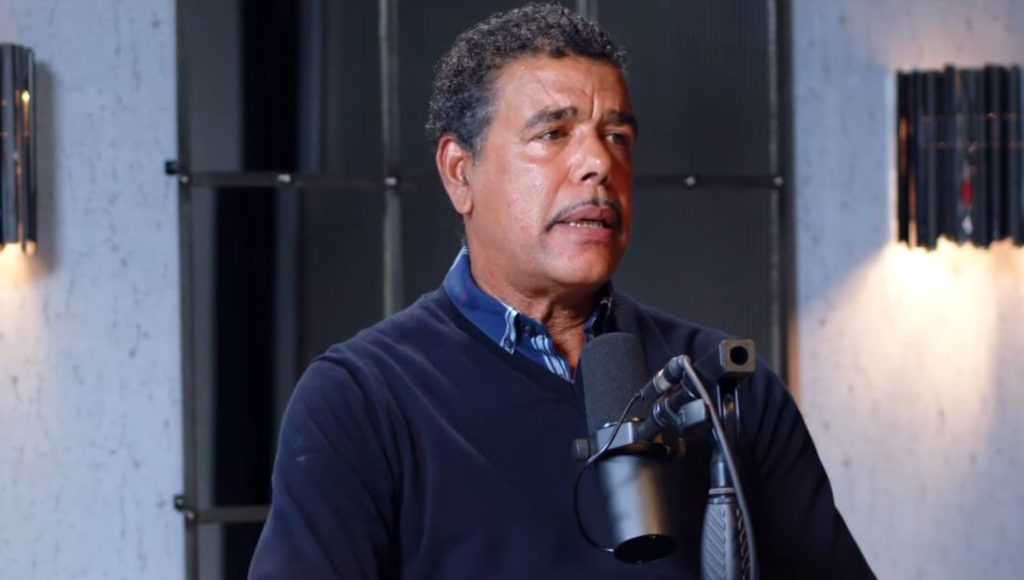
Credit: The Diary Of A CEO
Chris Kamara’s voice, energy, and emotion were the foundation of his career. Fans had known him for years as the man who would burst out laughing, charge through pitch-side banter, and utter famous lines like “Unbelievable, Jeff!” His voice was a connection rather than a commentary.
Then that connection started to deteriorate, slowly and perplexingly.
Kamara became aware of a problem in late 2021. Slurred sentences were spoken. His mouth trailed behind his racing thoughts. He initially attributed it to fatigue, aging, or even stress. However, the issue did not go away; rather, it got worse.
| Field | Information |
|---|---|
| Full Name | Christopher Desmond Kamara |
| Date of Birth | 25 December 1957 |
| Age | 68 (as of 2026) |
| Birthplace | Middlesbrough, England |
| Nationality | British |
| Profession | Former footballer, football manager, TV presenter |
| Known For | Sky Sports punditry, “Unbelievable Jeff” catchphrase |
| Health Condition | Diagnosed with apraxia of speech and dyspraxia (confirmed in 2022) |
| Major Recovery Steps | Speech therapy, experimental treatment in Mexico, hypnotherapy |
| Notable Publication | Kammy: My Unbelievable Life (autobiography) |
| Key TV Work | Soccer Saturday, Ninja Warrior UK, Goals on Sunday |
| Awards | MBE (Member of the Order of the British Empire) |
| Documentary | Lost for Words (ITV) |
| External Link | https://en.wikipedia.org/wiki/Chris_Kamara |
He had to face a much harsher reality by the beginning of 2022. Words weren’t landing correctly. Not only was his voice quieter, but it was also misfiring.
Ever the optimist, Kammy remained calm. Not externally, anyway. He said nothing about it for months. Surprisingly, he continued to appear on broadcasts, telling jokes and making the studio crews laugh. However, the reality was shifting beneath the surface. During a TV appearance, fans noticed that he was speaking more slowly and with an uneven rhythm. And the remarks started to circulate.
Doctors were perplexed behind the scenes. Thyroid? Maybe. Neurological? Most likely. The final diagnosis was apraxia of speech, a disorder that impairs the brain’s ability to organize and synchronize the movements required for speech. It’s about not being able to say the words, not about forgetting them.
Kammy’s physical coordination was impacted by dyspraxia. He said that while going upstairs was fine, coming downstairs felt like stepping into a fall he hadn’t yet experienced. This particular instance sticks out. For many who heard it, that image remained vivid and subtly frightening.
However, the comeback, not the condition, is what makes this story so captivating.
Instead of withdrawing, Kammy started investigating every avenue for recovery. He traveled to Mexico to receive radio wave stimulation, a promising but unorthodox treatment. He worked with a hypnotherapist and made a commitment to regular speech therapy back home. “The day you accept your condition is the day you start to improve,” he said, revealing that a single piece of advice altered his course.
That counsel turned into a game-changer.
As Kamara started talking more freely, the ITV documentary Lost for Words was produced, providing a very honest and poignant look into his experience. It was genuine, sometimes clumsy, but always hopeful; it wasn’t glossy or overly dramatic. Even though he stumbled over his words, viewers continued to smile. It was remarkably similar to the vulnerability that many people try to avoid. He made it public.
It wasn’t just a clinical shift. It was also emotional. Despite being one of the most animated characters on TV, Kammy had to slow down, stop, and listen during this journey. His relationship with speech changed from instinctive to deliberate. Speaking ceased to be a burden and instead became a conscious effort. It even developed into something to be proud of over time.
He went back to providing live commentary for Boxing Day football in 2024. It was a silent but profoundly potent moment. His spirit had not diminished, but his voice had changed, becoming softer and more deliberate. It had, if anything, gotten stronger.
There is more to Kamara’s story than just grief. It has to do with evolution. He sought to accept who he was becoming rather than struggle to return to his former self. That change is especially motivating for a public figure whose personality was previously characterized by speed, volume, and wit.
A more thorough examination of how he transformed adversity into strength can be found in his autobiography, My Unbelievable Life. By doing this, he has made room for people to speak up, including those who have speech impairments and anyone else dealing with an invisible issue.
His message is refreshingly honest: progress doesn’t always appear to be a return to “normal.” Finding a new version of yourself, one that moves more slowly, thinks more deeply, and speaks with earned wisdom, is sometimes necessary.
Chris Kamara might never be able to deliver his famous fast-paced delivery again. However, something even more enduring has taken its place: a voice that has gained new strength via tenacity.