
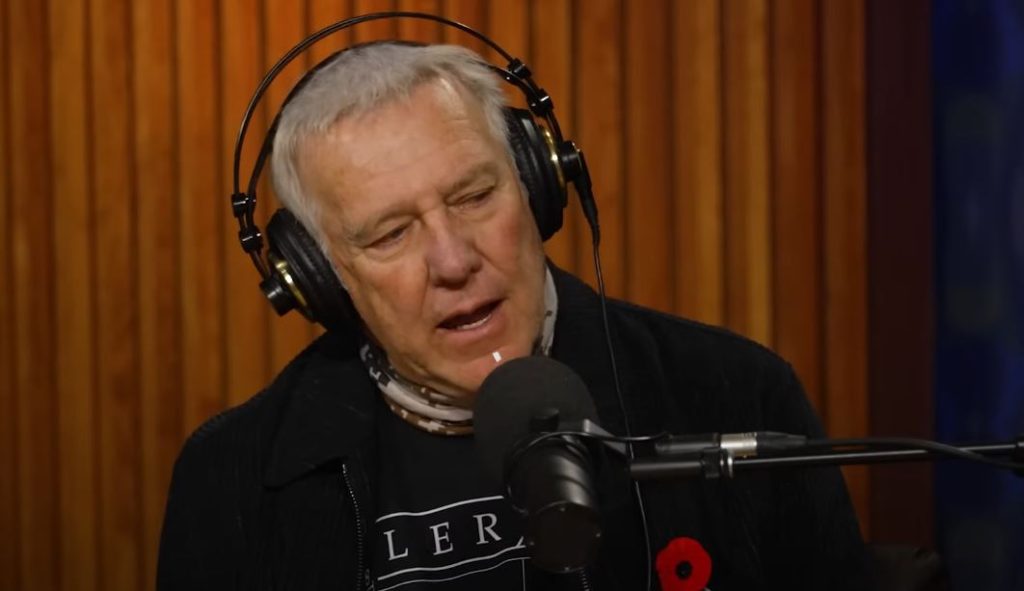
Credit: Q with Tom Power
Alex Lifeson has influenced guitarists for over 50 years with his unwavering inventiveness, unique tone, and razor-sharp accuracy. However, few fans could have predicted the struggle that lies behind his enduring genius. The Rush icon, who is credited with writing some of the most complex riffs in rock, has experienced a number of health problems that have drastically changed his day-to-day existence.
After undergoing stomach surgery in 2023, Lifeson developed gastroparesis, a disorder that causes digestion to sluggishly slow. He felt queasy, worn out, and irritated after meals that ought to have gone through his system in a matter of hours lingered painfully for almost half a day. He openly acknowledged, “I was miserable for a year and a half,” summarizing the never-ending cycle of discomfort that engulfed him.
| Full Name | Aleksandar Živojinović (known professionally as Alex Lifeson) |
|---|---|
| Born | August 27, 1953 – Fernie, British Columbia, Canada |
| Occupation | Musician, Guitarist, Songwriter, Producer |
| Associated Acts | Rush, Envy of None |
| Genre | Progressive Rock, Hard Rock |
| Major Health Conditions | Gastroparesis, Psoriatic Arthritis, Chronic Fatigue |
| Surgery | Stomach surgery in 2023 for gastroparesis |
| Treatment Center | Vivamayr Clinic, Austria |
| Lifestyle Changes | Quit alcohol and smoking, gluten-free and lactose-free diet |
In January 2025, Lifeson checked himself into the Vivamayr Clinic in southern Austria, a wellness center renowned for its holistic approach to gut health, determined to take back control of his health. The calm, simple, and distraction-free atmosphere of the clinic made him reset both mentally and physically. It’s nearly zen, he remarked. “Just tea, water, and quiet—no phones, no music. I learned how to pay attention to my body once more as a result.
It was a truly remarkable transformation. Lifeson’s condition significantly improved and he lost about 40 pounds over the course of the following 18 months. He adopted a strict, lactose and gluten-free diet and completely stopped drinking, using caffeine, and eating processed foods. He revealed, “I pay for it if I eat poorly.” I could suffer for three days if I make one mistake. But I feel amazing when I’m careful. His revitalized vitality is evidence that self-awareness can have an even greater impact than any medication.
This personal metamorphosis is similar to that of other artists, such as Bruce Springsteen and Elton John, who have also changed their health regimens in later years. Lifeson has demonstrated that recuperation is just as important to a musician’s longevity as performance, much like Springsteen, who recently took a break from touring to treat an ulcer-related illness. His candor regarding the difficulties of aging provides a welcome and genuinely human contrast to the unrelenting portrayal of rock star extravagance.
Lifeson has also struggled with psoriatic arthritis, an autoimmune disease that causes excruciating joint inflammation, for almost 20 years. It’s a particularly harsh curse for a guitarist whose profession depends on finger dexterity. He acknowledged, “There are times when my hands just don’t cooperate.” “I’ve learned to adjust, but I’ll shake them in between songs.” He has been compelled by the condition to alter his playing style, demonstrating that creativity frequently arises from constraint.
Lifeson is still receiving treatment with two biologic drugs, but he is optimistic. Although his regimen necessitates careful balance, he credits it with preventing the worst symptoms. He acknowledged, “It’s not perfect, but it works.” I find it to be incredibly effective. His fortitude is reminiscent of his late bandmate Neil Peart’s quiet resolve, whose personal health issues served as a lesson in how to remain composed in the face of adversity.
Lifeson’s present way of living is indicative of a significant change in priorities. He now starts his days early, frequently before the sun rises, and maintains a regular schedule of mindfulness exercises and gym visits. He makes his own food with natural ingredients and has found happiness again in simple, calming pursuits. He revealed, “My studio is my haven.” “In there, I never get bored. There is peace.
His artistic direction has also been impacted by his recuperation process. Moving away from Rush’s grand epics and toward something more contemplative and meditative, Lifeson has experimented with new textures and emotions with his band Envy of None. According to one critic, their 2025 album Stygian Wavz is a soundtrack for recovery, with traces of healing and renewal. Lifeson channels tranquility as well as sound through these songs.
His willingness to talk candidly about vulnerability is what most strikes me about his story. This story stands in stark contrast to the conventional perception of rock stars, who frequently hide their frailties behind their bluster. Fans have expressed admiration for Lifeson’s openness about his illness, and many have posted about their own experiences with autoimmune or digestive disorders in online forums. “If Alex can change his life at 70, so can I,” a fan wrote poignantly. These instances demonstrate how empathy can permeate music even after the amplifiers have stopped.
For Lifeson, health is now more about balance than survival. He stated bluntly, “I just don’t want to feel bad anymore,” echoing the silent feelings of millions. “I’ve come to realize that comfort is a necessity rather than a luxury.” His advice on how aging artists can regain control over their bodies and creativity resonates beyond the realm of music.
There are a lot of similarities with other musicians. Phil Collins has experienced spine problems that have prevented him from drumming, and Eric Clapton has talked about nerve damage that almost ended his career. Like Lifeson, every artist has had to face the straightforward reality that creativity can only be sustained via self-preservation. Lifeson’s attitude—his refusal to give in to resentment and instead choosing to grow with humor and humility—is what sets his journey apart.
Lifeson’s health has significantly improved in recent months, but he is still cautious. He avoids late nights, maintains a light schedule, and spends a lot of time with Rush co-founder and lifelong friend Geddy Lee. Their relationship, which has been based on years of cooperation and silent understanding, is still strong. He laughed and said, “We talk about everything—music, health, grandkids.” “Just two elderly men attempting to keep up with the times.”
In a time when discussions about mental health and chronic illness are becoming more commonplace, his story strikes a particularly deep chord. Lifeson has unintentionally turned into an advocate for aging with purpose by being open about his body’s limitations. For a genre that was formerly driven by rebellion, this change feels especially novel. The radical act of self-care is now the new manifestation of that rebellion.