
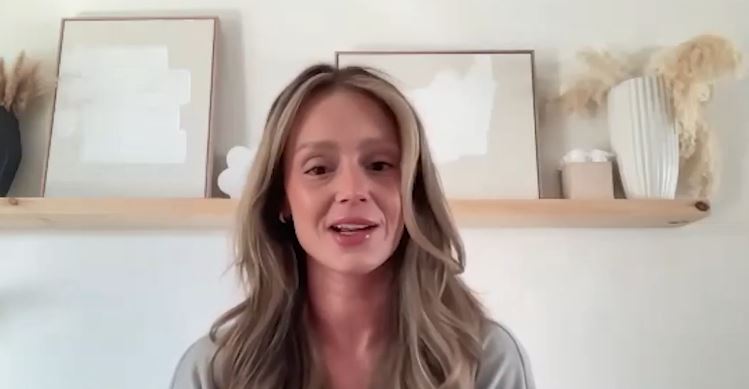
Mikayla Matthews recently posted an Instagram video in which she raises her hands to the camera. Around the joints, the skin is clearly red, irritated, and inflamed. In that moment, she merely lets you gaze without saying anything. And for some reason, that silence conveys more information than any medical statement or press release could. This is the true appearance of chronic illness. Hands that hurt when you move them, but no formal diagnosis.
The 26-year-old Matthews gained more public recognition thanks to Hulu’s The Secret Lives of Mormon Wives, a reality show that already thrives on conflict and honesty. However, the content she has shared since the beginning of 2026 goes far beyond drama on reality TV. She first identified her illness as Chronic Inflammatory Response Syndrome, or CIRS, in public in March. She claimed that extended exposure to mold toxins caused it. She posted, “This condition has stolen everything literally from me,” on Instagram Stories. She enumerated nerves, skin, brain, gut, liver, and hormones like that of someone listing losses following a fire. methodically. Since she’s had time to do the math.
Part of the issue is that most people are unfamiliar with the name CIRS. Exposure to biotoxins, usually from water-damaged buildings, causes this multi-system inflammatory illness. Dr. Ritchie Shoemaker was largely responsible for defining the condition, and despite an increasing amount of research supporting it, mainstream medicine has been slow to fully accept it. The kind of gap that allows someone to suffer for years without finding solutions is the one that exists between what patients actually experience and what doctors can identify. Matthews was in that void for a long time. She talked about avoiding eye contact with people for about a year and a half because she didn’t want them to see her skin. That is not a statistic related to medicine. That’s a life being dismantled in silence.
The familiarity of the pattern is what makes Mikayla Matthews’ illness so telling and frustrating. CIRS is frequently misdiagnosed as fibromyalgia, depression, or anxiety. Standard blood panels frequently yield unremarkable results, which can cause patients to feel as though they are dreaming and doctors to become skeptical. Although the exact number of people with undiagnosed CIRS is still unknown, researchers estimate that about 25% of people have genetic variations that impair their ability to properly eliminate biotoxins. Mold is more than just an allergen for those people. The body finds it difficult to turn off this immune response trigger.
Matthews stated that a period of filming that she subsequently linked to mold contamination on set coincided with her worst flare-up in more than a year and a half. Her symptoms were regularly brought on by returning to Utah from trips to California and Costa Rica. She clearly explained the difference in an eye-catching video that was uploaded in April 2026: she was dealing with a chronic illness in Costa Rica. She was barely getting by back in Utah. That distinction is important. Managing a condition is not the same as being controlled by it.
By May 2026, she had made a big decision: moving to Hawaii from Utah in the hopes that her body would begin to heal in a different setting. It may seem dramatic to relocate for health reasons, but clinical experts generally concur that significant recovery from CIRS is practically impossible while exposure persists. It is not optional to leave the building. This is the first step. Matthews had to relocate her family, which included her four kids, the youngest of whom was only a year old.
It’s difficult to ignore how much bravery that calls for, both in public and physically. In front of an audience that includes both ardent supporters and the typical skeptics, she is documenting a disease that still causes discomfort in some quarters of the medical community. She has openly stated that she attends events that she finds difficult to attend because she wants people who suffer from invisible illness to feel acknowledged. Above all, it is this impulse that distinguishes someone who is sharing their story from someone who is using it for a greater purpose.
It remains to be seen if Hawaii will bring her the healing she hopes for. Treatment for CIRS is difficult, slow, and not always successful. However, Mikayla Matthews’ illness, in all its agonizing, documented, unvarnished reality, has already served a purpose. It has given a condition that millions of people are silently battling without a diagnosis, without a language, and far too frequently without being believed a name, a face, and a pair of angry hands.
FAQs
1. What illness does Mikayla Matthews have?
She was diagnosed with Chronic Inflammatory Response Syndrome (CIRS) caused by mold exposure.
2. What triggered Mikayla Matthews’ CIRS?
Prolonged exposure to mold toxins, including during a contaminated filming period.
3. Why did Mikayla Matthews leave Utah?
Her symptoms consistently worsened there, so she relocated to Hawaii to heal.
4. How did CIRS affect Mikayla Matthews’ daily life?
It disrupted her skin, nerves, brain, hormones, and ability to parent normally.
5. When did Mikayla Matthews publicly reveal her diagnosis?
She first named CIRS publicly on Instagram Stories in March 2026.