
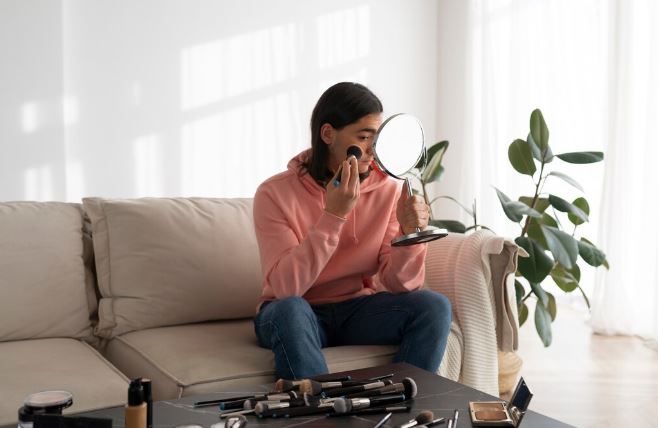
The desire to live an aesthetically pleasing lifestyle frequently starts as a tiny spark, such as the desire to make breakfast a little prettier or a shelf a little more organized. Before long, people are drawn into a carefully planned performance that subtly molds their perception of themselves. In recent years, the pursuit of aesthetic harmony has become remarkably similar to a part-time job, one that is done in kitchens, bedrooms, gyms, and cafés, where every element seems to ask, “Will this fit what I’m trying to be?” A kind of mild pressure that lingers in unexpected places is created when even those who begin casually quickly realize the emotional effort that lies beneath the surface.
| Aspect | Details |
|---|---|
| What “Aesthetic Lifestyle” Means | A visually curated way of living shaped by social platforms, emphasizing polished spaces, coordinated outfits, and mood-driven identity rather than genuine daily habits. |
| Core Psychological Pressures | Constant comparison, subtle performance anxiety, body monitoring, curated self-worth, aesthetic “rules,” and chronic fear of seeming out of sync. |
| Hidden Mental Costs | Emotional exhaustion, body dissatisfaction, financial pressure, loss of authenticity, perfectionism, reduced spontaneity, and distorted expectations about normal life. |
| Who Feels It Most | Gen Z, Millennials, creators, fashion and beauty professionals, young women, and anyone drawn to routine self-curation. |
| Why It Matters | These pressures reshape self-esteem, spending habits, identity formation, and social belonging, influencing how people measure value and success. |
| Helpful Reference Link | https://committees.parliament.uk/work/657/the-impact-of-body-image-on-mental-and-physical-health/ |
Many young people, particularly those in Generation Z, view this way of life as a form of personal branding that initially seems promising but eventually becomes burdensome, much like a camera lens that never turns off. They start to absorb aesthetic rules they never consciously agreed to—rules about perfect skin textures, minimalist color palettes, or the kind of calm that appears exceptionally staged—by continuously consuming streams of highly polished images. They frequently discover on quiet evenings that the pressure to look effortlessly sophisticated has severely diminished their capacity to savor messy, unplanned moments.
“I don’t even know if I like this style, or if I’ve learned to like it because everyone around me is leaning into it,” is a confession I’ve heard in various forms during conversations with friends and coworkers. These stories are remarkably similar to one another, almost like comparing notes from members of the same covert class. They are progressively enacting a visual identity that occasionally feels borrowed rather than lived by scrolling, saving, and recreating. Like steam building up behind a closed window, the emotional impact gradually increases even though the intention may begin as innocuous inspiration.
One of the most delicate topics influenced by these aesthetic narratives is body image. After all, a way of life that values symmetry, perfect lighting, and carefully regulated visuals eventually extends those standards to the human body. Researchers and government committees have cited studies that demonstrate how prolonged exposure to idealized images can exacerbate anxiety, increase body monitoring, and impair self-esteem in general. Many claim that they feel as though their bodies are continuously transformed into “projects,” modified, improved, and evaluated based on what makes for good photos. “Do I feel strong?” becomes less important than “Do I look right for the vibe I’m supposed to have?” in the inner monologue.
Researchers have discovered experiences in recent fashion model discussions that seem eerily similar to those of regular people embracing aesthetically pleasing lifestyles. Over the course of several hours of interviews, a number of models described how aggressive aesthetic expectations shaped their early careers, sometimes literally. According to one model, she felt as though her body was measured and assessed by an almost mechanical committee of invisible judges. Another described how being referred to as a “hanger for clothes” had such a profound effect on her that she internalized the term as a warning and carried it into adulthood. Even though these tales may seem extreme, the emotional reasoning behind them has started to permeate people’s daily lives outside of the fashion industry.
Calm minimalism is a common promise of aesthetic living, but the calmness belies the consistent effort needed to keep it up. It takes time, effort, and constant self-control to maintain a pristine kitchen or a free-floating shelf arrangement. Although minimalism may seem calming, for many people it becomes a never-ending cycle of purchasing, discarding, and reconsidering—especially when trends change every few months. Sociologists have characterized minimalism as a privileged aesthetic in the context of contemporary consumer behavior, in part because maintaining simplicity necessitates both cultural familiarity with specific design choices and financial stability. People who embrace minimalism online occasionally adopt a lifestyle based more on aspiration than reality, which subtly causes stress when real life doesn’t cooperate.
Affectionate living is frequently veiled by financial strain. In an attempt to feel more cohesive, people spend money on matching sets, popular skincare products, seasonal décor, or subdued clothing. However, the excitement of every purchase wears off quickly, and the emotional reward is rarely as great as the price. Friends have told me that they have felt surprisingly bad about purchasing things just to “stay on theme,” only to discover that the theme itself shifts more quickly than their budgets permit. Because it conflates money with identity, this cycle can be especially taxing, making every purchase seem like a failure or a moral upgrade.
Authenticity is sometimes more profoundly impacted by aesthetic lifestyles than people realize. I’ve seen friends stop in the middle of a conversation to take another picture of their drink because the foam wasn’t “sitting right.” Because the angle didn’t fit the tone of their grid, I’ve seen people rearrange breakfast plates three times. This habit gradually molds their perception of daily life. The appearance of the moment takes precedence over the actual moment—a small but important change that robs spontaneity and even happiness. Through these actions, identity shifts away from an internal, developing sense of self and toward a public persona.
Another layer of pressure is added by the growth of aesthetic medicine. People are frequently motivated by more than just the crease on their forehead as they experiment with Botox, fillers, and contouring procedures. Patients who come with emotional stories about heartbreak, career changes, lost confidence, or the unexpected shock of aging parents are often brought in by doctors who adopt a more holistic approach. Instead of the complaint itself, the wrinkle turns into a symbol. Some practitioners try to slow things down by integrating emotional context and promoting gradual treatment through careful consultations. This method is especially novel because it recognizes the reasons why people feel pressured to modify their faces to fit their online persona, even though it is not universal.
Millennials handle this environment in a different way. They feel pressured to keep up even though they recall a time before continuous curation. Many talk about the conflict between wanting to appear professional and wanting to completely reject perfectionism. One friend told me that she stays away from lip fillers because she is afraid that “if I start, I’ll lose track of where I stop.” This is a common sentiment among people who are torn between self-correction and self-care. Gen Z takes a preventative approach to aesthetics, aiming to postpone the onset of aging symptoms and establishing a completely new dynamic centered on risk assessment and future self-defense. Although both generations struggle with different forms of the same pressure, they both exhibit a tender desire to feel at ease in their own skin.
One thing comes out of discussions, studies, and firsthand experiences: people want to be beautiful, but they also want to be accepted for who they are. That permission is frequently suppressed by the aesthetic lifestyle that is currently popular on social media. Rules take its place: be simple but cozy, refined but organic, constant but constantly changing. People frequently observe how liberating it is to allow their home to be disorganized, their skin to have texture, their shelves to be mismatched, and their experiences to be unfiltered when they take a moment to step back, even if only briefly.
People are finding new ways to ease the pressure by adopting mindful consumption and authenticity. Some people are choosing to follow accounts that celebrate diversity, body variety, and genuine mess in order to more deliberately curate their feeds. By allowing their personalities to dictate their spaces instead of the current color scheme, some people are redefining what “aesthetic” means. An increasing number of people are sharing the “unaesthetic aesthetic” of their everyday activities, showcasing the allure of messy breakfasts and lived-in nooks. These seemingly insignificant actions have a remarkable effect on releasing the curated lifestyle’s emotional hold.
Many people are learning that aesthetics can be uplifting without becoming oppressive, expressive without becoming performative, and inspiring without becoming demanding as they continue to consider the forces forming their identities. A more sustainable and truly fulfilling life starts to take shape in the space between inspiration and expectation, which they are reclaiming by choosing self-expression over self-editing.