
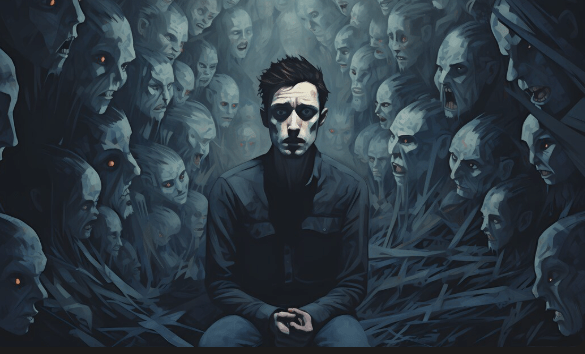
Long after everyone had gone to bed, a father of two sat at his kitchen table on a Tuesday night in late November. There was a hum from the dishwasher. His laptop was covered in a yellow circle by a lone overhead light. Emails were not being answered by him. He was switching between a spreadsheet called “Emergency Scenarios” and a retirement calculator, changing figures, reducing projections, and increasing worst-case scenarios.
| Category | Information |
|---|---|
| Topic | Men’s Mental Health & Invisible Cognitive Load |
| Core Concept | The “existential load” linking identity to provision and protection |
| Key Statistic | 86% of men still link manhood to being a provider |
| Psychological Themes | Vigilance, emotional suppression, identity fusion with earning |
| Referenced Organization | Psychology Today |
| Reference Link | https://www.psychologytoday.com |
It might have appeared to be routine work from the hallway. It wasn’t.
It’s possible that many men carry a continuous, unnamed background surveillance system in addition to stress.
We’ve gotten comfortable discussing the mental burden that women bear, such as scheduling playdates, keeping track of grocery lists, and remembering dentist appointments. That work is genuine, quantifiable, and deserving of acknowledgment. However, there is another type of cognitive weight that runs concurrently; it is more existential and quiet and frequently combines with identity.
Researchers discuss what some refer to as the “existential load” in recent Psychology Today articles. According to survey data cited there, 86% of men still associate being a provider with being a man. That figure persists. It implies that earning is more than just a contribution for many men. It is evidence of value.
“I am because I earn.”
Usually, people don’t say that aloud. It hums under objects.
On a Saturday afternoon, a man is cleaning gutters outside a suburban house while looking at his phone to see how the market is doing. Inside, his partner is frosting cupcakes, texting parents, and planning a birthday party. Both are in operation. However, his mind is looking farther ahead, considering things like interest rates, job security, insurance renewals, and the cost of braces in five years.
Men seem to be mentally rehearsing “what if” scenarios all the time. What happens if the contract doesn’t work out? What if there are layoffs? What happens if the roof leaks and the car dies in the same month? It’s risk management under the guise of pragmatism.
Additionally, it is difficult to turn off.
This vigilance starts early for some people. Boys are commended for their toughness and ability to solve problems on their own. “Don’t whine.” “Be strong.” Resilience frequently takes precedence over emotional fluency. Many men have impressive crisis-management skills by the time they reach adulthood, including the ability to negotiate pay, refinance loans, and fix broken pipes at midnight. However, it’s easy to overlook the emotional price of being the reliable anchor.
It’s still unclear if younger generations are relieving this burden or if it’s just taking on a different shape.
The pressure can continue even in households where women earn more than men. Payroll changes don’t cause cultural scripts to disappear. Counselors say they hear variations of the same fear in therapy offices: “If I fail financially, I fail completely.” This combination of income and identity can stifle creativity and subtly influence behavior.
Fear could be the cause of what appears to be overwork. What appears to be detachment could actually be calculation.
This leads to an implicit specialization in some partnerships. “You manage emotions and timetables,” he suggests. “I’ll take care of our survival.” It’s not a malevolent division. It offers protection. However, isolation can turn into protection.
It’s difficult to ignore the fact that many men use action to cope with their anxiety. Additional hours. Additional side projects. More monitoring. Investors appear to think that hustle equals security, and this belief is reinforced by the larger culture. However, continual watchfulness can limit empathy. Even little pleasures blur at the edges when someone is looking for disaster.
A child displays a drawing made with crayons. Distracted, the father grinned and mentally calculated the price of summer camp.
That diversion isn’t a sign of indifference. Cognitive overload is the cause.
The emotional silence is another layer on top. Many men don’t talk about this internal pressure because they lack the words to describe it or because doing so would be seen as a sign of weakness. One factor is protectionism. Why worry about a market meltdown with a partner? Why disclose concerns about the stability of one’s career?
Ironically, silence has the power to increase distance.
Partners may mistake irritability or withdrawal for disengagement if vigilance is not visible. The man may actually be carrying mental spreadsheets of the worst-case scenarios in an attempt to guarantee that everyone else can sleep soundly.
This discussion is made more urgent by statistics. The majority of suicides in a number of Western nations are committed by men. Risk is increased by economic instability. Although that correlation does not establish causation, it does cast doubt on the psychological significance of provision.
Transitions in life are also accompanied by an identity crisis. Standing in a hospital room and gazing at a swaddled baby, a new father may experience both awe and an instantaneous surge of calculation. diapers. money for college. medical care. The happiness is genuine. And the silent fear of “Am I enough”?
Seeing this play out over generations reveals a complex issue. Compared to their own fathers, fathers today attend more school functions, change more diapers, and talk more candidly about parenting. Nevertheless, the provider script persists, subtly suggesting that love needs to be demonstrated via financial gain.
Naming this hidden load might cause it to be redistributed.
Something changes when men express their worries about things like job security, financial “slippage,” and not measuring up. Instead of being solitary, the vigilance becomes shared. A surprising sense of relief is frequently reported by couples who open spreadsheets together and discuss worst-case scenarios without feeling ashamed. The figures are not instantly altered. However, the seclusion does.
This isn’t a contest to see who can carry the most. There are various forms of invisible labor. Ranking suffering is not the aim. It is to acknowledge intricacy.
The father isn’t pursuing ambition by himself as he stands in that kitchen late at night with his laptop glowing. In an uncertain world, he is attempting to establish certainty. It could be a self-imposed burden, a cultural burden, or an inherited burden. However, it weighs a lot.