
Watching one of the most influential men in international sports admit in a few sentences that he is essentially fighting against his own biology is somewhat startling. In a recent interview with Ring Magazine, Turki Alalshikh, the Saudi chairman who has spent the better part of a decade changing professional boxing from the outside, said something that would stop a room. He clarified that his goal is to make boxing more peaceful. Before he forgets his name, he wants to do it.
In 2015, the 44-year-old received multiple cancer diagnoses. Given how aggressively public his boxing work has been, it seems like he made a conscious decision to keep the majority of it private. The most serious diagnosis concerned a brain tumor near the pituitary gland. While the world went on with its business, he quietly received treatment in New York for the majority of 2018 and 2019. He didn’t start pressuring Saudi Arabia to make significant investments in the sport until after his return.
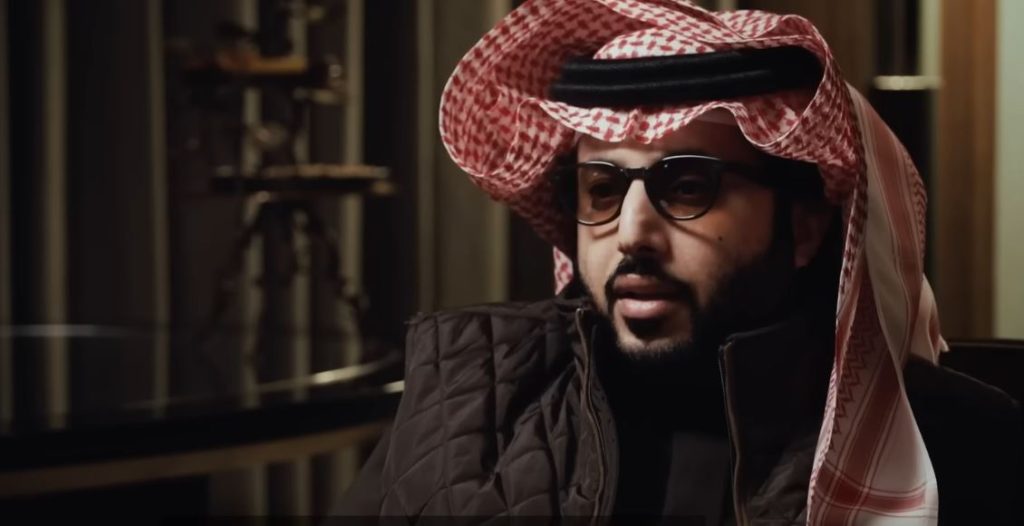
His right kidney has become atrophic, or essentially shrunken, according to a medical report that surfaced more recently. This is probably a long-standing or congenital condition. Alongside the disclosure of the brain tumor, that detail—which was presented almost as an aside—hints at a physical picture that is far more complicated than anyone outside of his inner circle likely realized. Even people close to him might not have realized the extent of it until recently.
The emotional register he employed in the Ring Magazine interview is what sets it apart. That’s not how this man speaks. His public persona is one of announcements and dealmakers, of high-stakes negotiations carried out with the assurance that comes from wealth and power. “I’m afraid in 2028 or 2029 I’ll forget my name” is a completely different statement. It lands differently. It seems as though he intended it to.
Despite all of this, his boxing aspirations are still remarkably clear. Dana White, Eddie Hearn, Frank Warren, and Nick Khan are four men whose professional relationships range from icy to overtly antagonistic, and he told Ring Magazine that he wants to arrange a meeting between them. On a good day, it would be considered ambitious to get Hearn and White together without a press conference turning into a verbal sparring match. However, Alalshikh has accomplished more difficult tasks. In 2024, he persuaded Warren and Hearn to co-promote the same card, which was akin to witnessing the signing of a peace treaty between two nations.
It’s difficult to ignore the urgency that permeates his most recent remarks. Alalshikh is not discussing legacy in the abstract manner that influential people frequently do as their careers come to an end. Cognitive timelines are what he is discussing. about recollection. regarding a window that might close before the task is completed.
The Fury-Usyk undisputed fight and the Zuffa Boxing launch alongside White are two examples of his years-long output that may have demonstrated this urgency, but the cause is only now becoming apparent. Nobody knows if he will be able to bring boxing’s rival promotional factions together before his health deteriorates. However, it’s becoming more and more clear that he plans to try, and on a schedule that only his doctors fully comprehend.
FAQs
Q1. When was Turki Alalshikh first diagnosed with cancer?
He was first diagnosed with multiple forms of cancer in 2015.
Q2. Where is Turki Alalshikh’s brain tumour located?
The tumour sits close to the pituitary gland in his brain.
Q3. What additional health condition has Alalshikh recently disclosed?
His right kidney has become atrophic, likely a long-standing congenital condition.
Q4. What did Alalshikh say about his memory in Ring Magazine?
He fears he may forget his own name by 2028 or 2029.
Q5. Who does Alalshikh want to unite before his health worsens?
He wants to bring together Dana White, Eddie Hearn, Frank Warren, and Nick Khan.