
There is a certain cruelty in timing: an illness can strike right when everything you’ve worked for is finally coming together, rather than during a quiet period. Jayne Kennedy experienced that. She was one of the most well-known figures in fitness media in the early 1980s, coexisting peacefully with Richard Simmons and Jane Fonda as a key figure in the wellness movement of the time. One of her best-selling books was Love Your Body. She was watching it take off after writing it, producing it, and organizing every detail of its launch. She was then unable to perform a sit-up almost overnight.
Kennedy’s description of that period’s shock strikes a deeper chord than any dramatization could. “I was right up there in the top three with Jane Fonda and Richard Simmons,” she said. “And then I suddenly reach a point where I am unable to perform even a sit-up. I had endometriosis and was very ill. Many people still have misconceptions about the condition, which causes tissue that resembles the uterine lining to grow outside the uterus. It was hardly noticed by medical professionals in the early 1980s, especially for Black women.
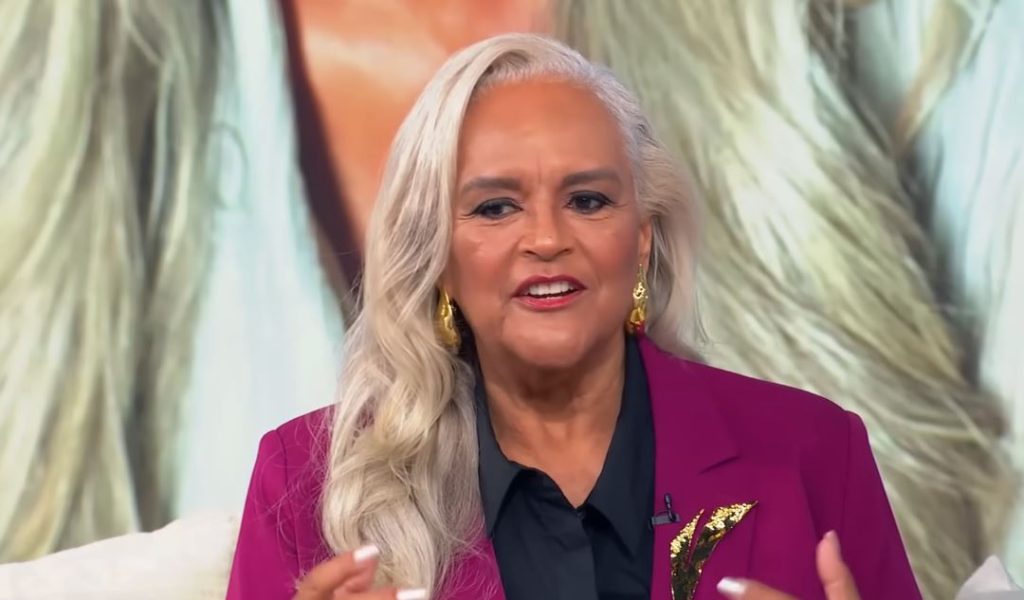
Kennedy has described the pain as unrelenting and specific, with sharp, abrupt flare-ups that could occur while she was standing in a kitchen lifting the lid off a pot rather than dull background aches. Walking became challenging. The foundation of her entire professional brand—exercise—became nearly impossible. Over the course of three days, she underwent testing at a hospital in Los Angeles before a diagnosis verified the doctors’ suspicions. She had never heard the term “endometriosis” before.
The setting in which this story took place is what makes it so remarkable. Kennedy began a career that had already made history when she joined CBS’s The NFL Today as one of the first Black women to co-anchor a major national sports broadcast. At one point, she was traveling 255 days a year. Her body practically forced her to stop, but she had been going at that speed for years. There was neither a planned sabbatical nor a graceful pause. Only the sickness, followed by the quiet.
Eventually, a doctor informed her that although there was no cure, there was a treatment that occasionally worked. Pregnancy was suggested. Kennedy became pregnant in just three months. Kennedy accepted rather than questioned a medical recommendation that served as both a life event and an unusual chapter in an already unusual life. Her ability to move forward even when the path doesn’t appear to be what was intended speaks to something about her personality.
Before a hysterectomy finally ended the suffering, the illness continued for over ten years. The entertainment industry, as it usually does, moved on without leaving a door open during those quieter but active years. Kennedy eventually rose to the position of national spokesperson for the National Endometriosis Association, specializing in women of color, who continue to receive disproportionately few diagnoses. It’s the kind of change that, in hindsight, seems intentional, but at the time, it most likely felt like survival.
All of this is openly discussed in her memoir, Plain Jayne, which shapes her view of resilience as something she had to repeatedly practice in physically and professionally taxing circumstances rather than as an abstract virtue. It seems as though the illness is not a plot point in her story when you read about those years. It is near the center of it; yes, it was the thing that stopped the momentum, but it was also the experience that helped her better understand what she was fighting for.
She has given clear and specific advice to other women who may be able to identify the symptoms: don’t ignore ovarian pain, don’t accept a hysterectomy without first ruling out endometriosis, and don’t take medical advice at face value. Someone who endured illness in a passive manner would not offer such well-earned advice. It comes from someone who, at a time when the illness was both medically and culturally obscure, had to figure it out mostly without a map. As it happens, that sums up the majority of Jayne Kennedy’s life pretty well.
FAQs
1. What illness did Jayne Kennedy suffer from?
Jayne Kennedy was diagnosed with endometriosis during the peak of her career.
2. How did her illness affect her career?
It forced her to abandon her thriving Love Your Body fitness empire entirely.
3. What treatment did her doctor recommend?
Her doctor suggested pregnancy as the most effective available treatment at the time.
4. How long did Jayne Kennedy battle endometriosis?
The illness persisted for over a decade before a hysterectomy ended her pain.
5. What did Jayne Kennedy do after recovering?
She became a national spokesperson for the National Endometriosis Association, especially for women of colour.