
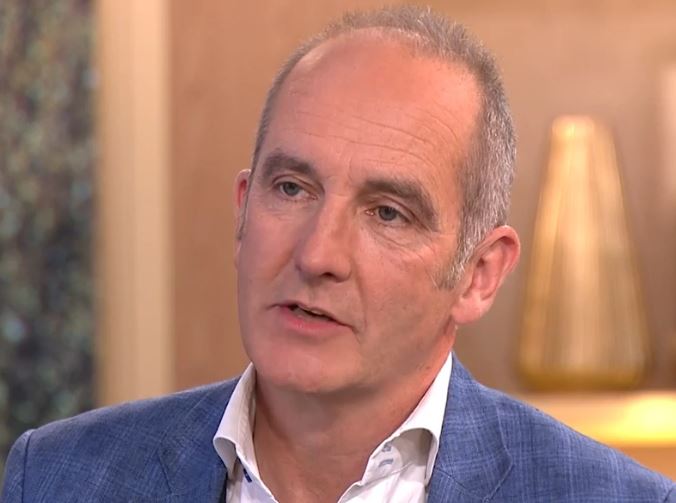
The majority of people believe they are familiar with one version of Kevin McCloud. He asks insightful questions about cantilevers while standing on hillsides in exquisitely cut jackets and tilting his head at architectural models. He is exact, articulate, and seemingly unflappable; he is the type of man who seems to have thought through every human emotion beforehand and neatly stored it away. However, if you spend enough time watching Grand Designs over the course of its more than 25 years on Channel 4, a different picture becomes apparent. One in which virtually every episode revolves around Kevin McCloud’s personal relationship with health, both that of others and, subtly, his own.
According to McCloud, there have been two or three heart attacks among Grand Designs participants during the series. These men have pushed themselves to build what he called monuments to their own ambition, only to find themselves recuperating in hospital beds and abruptly changing their minds about everything. He has discussed those times with a tone that borders on melancholy, pointing out that nearly all of the men involved expressed regret and stated that their families were more important than the concrete and glass surrounding them. It’s difficult not to wonder if McCloud has quietly absorbed some of that same reckoning after spending more than 20 years witnessing people exhaust themselves in search of beautiful spaces.
A particularly moving episode of Grand Designs, which took place close to Henley-on-Thames in October 2024, followed Tony and Ara as they set out to demolish a family home and construct a woodland sanctuary that was solely focused on health and wellbeing. After being diagnosed with an autoimmune disease, Ara left a corporate career to pursue something more: a place that focused on living well rather than just living. Tony assumed the massive responsibility of overseeing the construction on his own. McCloud was reportedly moved to tears by what transpired during that episode, which felt less like television and more like something that was actually shattering his professional composure.
The fact that physical vulnerability and illness have frequently surfaced throughout the show’s history, and McCloud has never quite figured out how to keep them at bay, may be the reason that moment struck such a deep chord. In a previous series, he got to know Michelle Parsons, an artist who, after recovering from a severe illness, made the decision to construct her own private woodland retreat in Essex. This project was born out of confronting mortality and making the decision to act rather than wait. These are not program-related incidental details. In many respects, they are the purpose of it. When people are afraid, they build. When they wish to leave something behind, they construct. And McCloud appears to carry that knowledge, having sat with it for more than 20 years.
McCloud’s career has always been based on the relationship between aesthetics and the human condition. He was born in Bedfordshire in 1959 and received his education at Cambridge, where he studied art and architecture alongside Hugh Laurie and Stephen Fry in the Footlights ensemble. He received theater design training. Before attending college, he sang opera in Italy. At one point, he ran his own lighting business with twenty-six employees. It seems that none of it adequately prepared him for what Grand Designs would really require of him, which was to repeatedly witness people at their most broken and hopeful.
Watching some of the more emotionally raw episodes gives one the impression that McCloud’s true talent is not just in his understanding of architecture but also in his ability to create space for narratives that transcend foundations and floor plans. Grand Designs has always been a program about human endurance wearing the costume of construction, whether it is a couple navigating a cancer diagnosis mid-build, a veteran building a home after losing three limbs, or someone building as an act of recovery from a serious illness. McCloud has supported it all. That probably doesn’t look good on camera, whatever toll it takes on someone who truly cares.
What is evident is that Kevin McCloud, who is currently in his mid-sixties and continues to walk construction sites with the same restless curiosity that he brought to the first episode in 1999, has an understanding of illness and resilience that transcends the boundaries people erect around themselves. He has witnessed the physical effects of severe stress. He has seen individuals turn their sorrow, anxiety, and diagnosis into the process of creating something lasting. Only he would know if that teaches you to take better care of yourself or just makes you more acutely aware of how quickly things can change.