
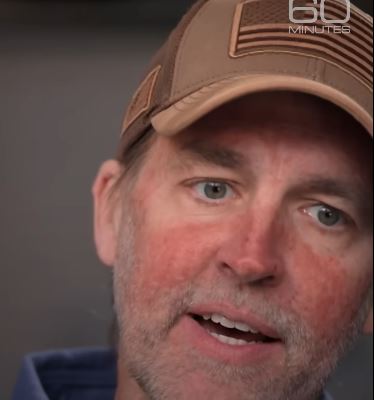
Observing a politician openly discuss his own demise has a way of resetting the atmosphere. The former Republican senator from Nebraska, Ben Sasse, has been doing that for months, and it doesn’t get any easier to observe. He talks about his daughters, jokes about keeping the pharmacy in business, and sits in front of cameras with the dried red marks of a drug rash crusted across his face. Despite all of this, he somehow comes across as less performative than most healthy people on television. He seems to have discovered something that the rest of us are still trying to figure out.
Late in 2025, the diagnosis was made. What Sasse had thought to be the aftereffects of triathlon training—persistent back pain and stomach discomfort—turned out to be much worse. According to him, a full-body scan revealed that his torso was “chock full of tumors.” Stage 4 pancreatic cancer has already spread to the lungs, liver, lymph nodes, and vascular system. At first, the doctors gave him three to four months. At the time, he was fifty-three years old, had three children, the youngest of whom was only fourteen, and had been married for thirty years.
| Bio Data / Key Information | Details |
|---|---|
| Full Name | Benjamin Eric Sasse |
| Born | February 22, 1972, in Plainview, Nebraska |
| Age | 54 |
| Spouse | Melissa McLeod (m. 1995) |
| Children | Three |
| Education | Harvard (BA), St. John’s College (MA), Yale (MA, MPhil, PhD) |
| Political Party | Republican |
| Senate Tenure | January 2015 – January 2023 |
| Notable Role | 13th President, University of Florida (Feb 2023 – July 2024) |
| Diagnosis | Stage 4 pancreatic cancer, metastasized to the liver, lungs, lymph nodes, and vascular system |
| Diagnosed | December 2025 |
| Initial Prognosis | Three to four months |
| Current Treatment | Daraxonrasib (clinical trial drug from Revolution Medicines) |
| Tumor Reduction | Approximately 76% as of April 2026 |
| Faith | Reformed Christian; member of the Presbyterian Church in America |
| Residence | Austin, Texas |
It’s not just the candor that sets his case apart. It’s the medication. Sasse is participating in a clinical trial for daraxonrasib, an oral targeted treatment created by the California biotech company Revolution Medicines. It targets RAS gene mutations, which are found in more than 90% of cases of pancreatic cancer. Researchers have been pursuing this notoriously difficult target for decades. His tumor volume has decreased by about 76% as of April 2026. That’s a remarkable figure for a disease where, once metastasis occurs, the five-year survival rate is only about three percent. No one is calling it a cure, but doctors are keeping a close eye on cases like his. According to Sasse, the cancer has “seeded” in areas that are still present. He refers to them as weeds.
The adverse effects are severe and obvious. His face now appears, in his own words, nuclear due to a bleeding rash caused by the drug’s interference with normal skin growth. In the late April 60 Minutes interview, Scott Pelley sat opposite a man whose appearance was shocking but whose voice was slow and, at times, almost joyful. Sasse’s statement that he detests cancer but is thankful for it would sound theatrical to almost anyone else. It sounded earned from him.
His career in politics was never quite right. A Republican with a PhD in history from Yale, a former president of a university, and a vote in favor of Donald Trump’s conviction during the second impeachment trial resigned from the Senate to lead the University of Florida, where his presidency came to an end after eighteen months and a crucial state audit. The Florida chapter complicates the legacy. In a way, the cancer has made it easier. Regardless of your opinion of his politics, it’s difficult to ignore how much of his remaining time he is choosing to devote to issues that practically no one in Washington cares about: neighborhoods, local civic life, and the quiet collapse of communities that he feels contribute to the louder dysfunction in D.C.
He discusses his 22 and 24-year-old daughters and the likelihood that he won’t be able to walk them down the aisle. Regarding his son, who will require support from other men. About Melissa, his 31-year-old wife, who has been dealing with her own health problems, the epilepsy diagnosis that led to his resignation in Florida. It’s all delivered without self-pity. It sounds more like a man taking stock aloud while there’s still time.
Observing him over the past few months, it seems that the most valuable legacy he may leave behind isn’t a book or a policy, but rather the way he’s modeling something that most Americans don’t think about until they can’t. Rarely do stories about pancreatic cancer have a happy ending. Sasse appears to be the most knowledgeable about that. However, the drug is buying him time, and he is using that time to talk to reporters, his church, and anybody who will listen, acting as though he has finally been given the task.