
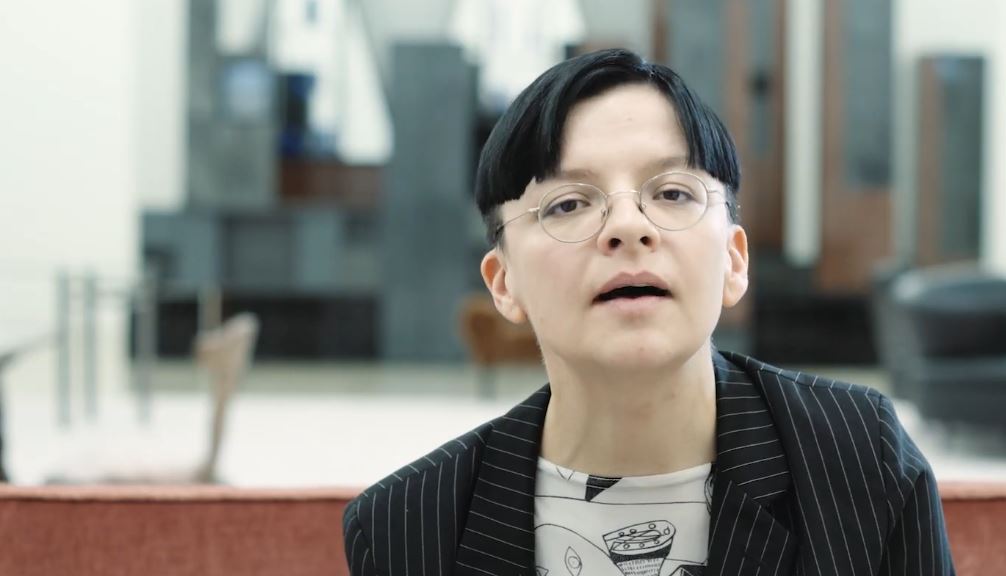
Credit: Haus der Kunst
I nearly missed the point when I first saw one of her installations.
A sagging sofa, a beige plastic rotary phone, and a laminated wall unit gave the impression that someone had turned a small East German living room into a gallery. The carpet had a subtle, artificial scent, similar to what you might encounter in a provincial insurance office back in 1994. This was the trap.
| Category | Details |
|---|---|
| Name | Henrike Naumann |
| Born | 1984, Zwickau, German Democratic Republic |
| Died | 14 February 2026, Berlin, Germany |
| Education | Dresden Academy of Fine Arts; Konrad Wolf Film University of Babelsberg |
| Known For | Installation art using 1990s East German furniture to examine political memory |
| Major Milestone | Selected to co-design the German Pavilion at the 61st Venice Biennale (2026) |
| Reference | https://en.wikipedia.org/wiki/Henrike_Naumann |
Henrike Naumann realized that monuments are not how history announces itself. It blends in with the furnishings in silence. The optimism of flat-pack cabinets bought after 1990, when the borders opened, and Western catalogs arrived like scripture, conceals it in veneers and knobs.
She was born in Zwickau in 1984 and was among the final generation to recall the GDR as an atmosphere rather than an ideology. She grew up during the turbulent reunification period, and she would go on to call November 4, 2011, the day the National Socialist Underground was revealed, a watershed moment. Beate Zschäpe had set fire to the Zwickau flat while she was just a few hundred meters away.
That closeness helped her focus. Inquiries were conducted in the 1990s in ordinary rooms.
She recreated the inside of a flower shop in pieces, such as “14 Words,” referencing the racist catchphrase associated with neo-Nazi violence. She created a sort of Stonehenge out of wall modules in “Das Reich,” putting the Reichsbürger movement and home design in conflict. Though dramatic, the gesture was never hysterical.
It was evident that she had received training in stage and set design. Every perspective seems deliberate. Before you knew you were being positioned, the space had you under its grasp.
She flipped furniture 90 degrees and covered gallery walls with carpet for the 2019 exhibition “Ostalgie,” causing cabinets to cling to vertical surfaces and framed photos to lie beneath the floor. Before entering, visitors paused. The work included that hesitancy.
I recall a brief moment of discomfort at how familiar everything appeared.
Her generation struggled with inherited aesthetics that were neither quite guilty nor innocent. Prosperity was promised by reunification, but it also brought about discontent, privatization, and displacement. In East German memory, the Treuhandanstalt remains like an unwelcome auditor.
Naumann refused to be stereotyped. She did not dismiss East Germany as a victim or condone the radicalization of the extreme right that followed. Rather, she created spaces where IKEA modernism and the specters of prefabricated Plattenbau apartments collided, and rave culture brushed against nationalist nostalgia.
Tension was always present. Sometimes, critics questioned if she ran the risk of aestheticizing neo-Nazi allusions by using them. Others contended that she exposed the ordinariness of extremist ideology more successfully than overt denunciation ever could by integrating it into everyday home life.
Both interpretations are valid.
Later, she broadened the scope of her work. Through the disturbing transatlantic echo of Federal-style furniture, “Rustic Traditions” explored the January 6 Capitol attack in the United States. War interrupted her displays in Russia and Ukraine; in 2022, one installation had to be removed from Kyiv.
Her obsession with architecture as ideology grew as a result of that encounter. She believed that a chair could convey a geopolitical message.
It felt like institutional endorsement of a voice sculpted by the margins when she and Sung Tieu were chosen to co-design the German Pavilion for the 61st Venice Biennale. The United Nations has rarely been represented abroad by East German artists.
Only a few months before that pavilion was scheduled to open, she passed away in February 2026 after receiving a late cancer diagnosis. She had demanded that the work be conceptually completed so that it could move on in accordance with her vision, according to confirmation from the Institute for Foreign Cultural Relations.
That seems like a typical insistence.
In person, her voice was quiet, even circumspect, as though she were weighing each word carefully. Her political views were not ostentatious. The arrangement held the drama.
A stack of wall-unit panels leaned against the wall like patient performers waiting for a rehearsal during one of her studio visits. Somewhere in the background, a kettle hissed. Berlin traffic hummed apathetically outside.
Her artwork never stood out. It was rearranged.
Her ability to transform something as ordinary as a living-room cupboard into a diagnostic instrument is still remarkable. She viewed furniture as proof of denial, compromise, and aspiration.
The lingering rifts of reunification were not addressed by Henrike Naumann. She provided places where you could feel the cracks beneath your feet.