
On Wednesday, a bouquet of flowers was discreetly placed at the base of a mural depicting her at San José State University. No formalities. No announcement. Only flowers, from someone who knew what had been lost. On October 28, 2026, Dolores Huerta, co-founder of the United Farm Workers and arguably the most influential labor organizer in American history, passed away in Bakersfield, California. She was ninety-six. Her family confirmed that she passed away from cancer while surrounded by her loved ones, including four generations of family. This seems like a fitting conclusion for a woman who dedicated her life to creating things that would outlive her.
She was born in the now-defunct coal-mining town of Dawson, New Mexico, in 1930. For a woman who devoted her life to fighting for those the nation chose not to see, that origin—from a place that literally vanished—somehow makes sense. When she and César Chávez co-founded the National Farm Workers Association in 1962, farmworkers had little chance of gaining collective voice or legal protections. The majority of organizers rejected the notion of forming a union. Huerta did not contest the argument. She simply left for work.
She was the UFW’s vise president for almost forty years, negotiating contracts, organizing boycotts, and showing up in fields, statehouses, and TV studios to demand that the workers who harvested America’s food be treated with basic dignity. Her work gained national attention during the Delano Grape Strike, but she also experienced the less glamorous years of door-to-door organizing, late-night strategy meetings, and unrelenting movement management. Huerta coined the phrase “Sí, se puede,” which Barack Obama admitted he modified for his own “Yes, we can” without always giving due credit. “As usual, Dolores got there first,” Obama said on Wednesday, displaying his trademark self-deprecation.
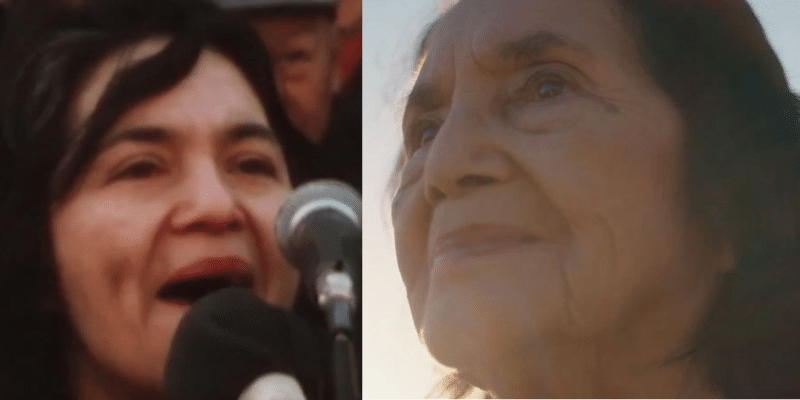
It would be impossible to discuss her passing without bringing up what she disclosed earlier this year. Huerta claimed in a statement to The New York Times that César Chávez had sexually assaulted her and several other women, leading to two pregnancies. She had been silent for decades, in part because she was afraid that if she spoke up, the movement she had dedicated her life to would be destroyed. Even at ninety-five, she finally spoke. There’s a kind of bravery there that’s hard to describe. It wasn’t the bravery of a young person who had everything in front of her. She decided the truth was more important than the legend, so she made the reckoning public. It was something older and more deliberate.
She had been protesting ICE operations sweeping through the San Joaquin Valley in recent months, showing up for the same communities she had spent sixty years defending, despite her health deteriorating. On Wednesday, Cecilia López Mora, a grape harvester in the Wasco area in the mid-1990s, claimed that Huerta was the reason she was paid more in the fields. She remarked in Spanish, “She knew what it was like.” “She assisted individuals such as ourselves.” That brief and straightforward statement most likely sums up Huerta’s legacy more effectively than the majority of formal tributes.
Vigils swiftly increased in Phoenix, Bakersfield, and Albuquerque, close to her birthplace. Gavin Newsom, the governor of California, issued an order to lower the flags to half-staff. Obama, Kamala Harris, Eva Longoria, and numerous others paid their respects in waves. Clearly, they were sincere. However, in some respects, the most sincere homage has already begun: farmworkers in the fields this week who went to work in the dark, returned home to discover she was gone, and continued on because that is what she always did.
Dolores Huerta lived long enough to speak the hard truths she had kept to herself for decades and to witness the success of much of what she had created. Few people receive both. To put it simply, she was indispensable.