
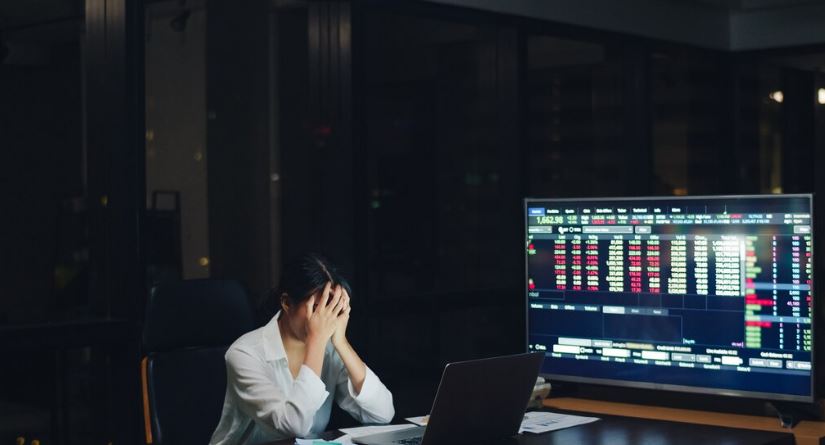
On the morning following a crash, a certain kind of silence descends upon Seoul’s financial district. The triangular kimbap is still being sold in the convenience stores, and the cafés around Yeouido are still packed, but there is less talk. People spend far too much time staring at their phones. Without looking up, someone at the adjacent table updates a brokerage app. That was the situation during the week of March 4, when the KOSPI lost almost a fifth of its value in just two trading sessions. This was the worst period since 2008 and worse in a single day than the 9/11 aftermath.
It’s not just the size of the drop that makes this episode unsettling. It’s the speed. A few weeks prior, an AI-chip frenzy had caused the same index to rise more than 40%, attracting a wave of retail traders known as “ants” who borrowed at record levels to ride the wave. The amount of margin debt increased to about ₩34 trillion. Subsequently, a conflict in the Middle East, an increase in the price of oil, and a surge in algorithmic margin calls did what mathematics usually does in overconfident markets. In just 48 hours, the trade collapsed.
| Event Snapshot | Details |
|---|---|
| Market | KOSPI (Korea Composite Stock Price Index) |
| Operator | Korea Exchange (KRX), headquartered in Busan |
| Crash Window | March 3–4, 2026 (approximately 48 hours) |
| Peak Single-Day Drop | KOSPI fell roughly 12% on March 4 — the steepest one-day decline on record |
| Two-Day Loss | Around 18–20% of the index value was erased |
| Margin Debt at Peak | ₩34 trillion (record high) |
| Primary Triggers | AI-chip euphoria reversal, U.S.–Iran conflict, energy-import shock, algorithmic margin liquidations |
| Most Affected Sectors | Semiconductors, shipping, logistics (Samsung Electronics, SK Hynix, HMM, Pan Ocean) |
| Regulatory Response | Circuit breaker activated after 8% threshold; stabilization measures coordinated by the Financial Supervisory Service |
| Retail Investor Base | Roughly 11% of Koreans aged 30–60 directly invested in equities |
| Historical Parallel | October 2008 crash — KOSPI fell 22.67%; documented spike in suicide rates the following month |
The euphoric stage was an animal unto itself. The group chats, the half-joking talk of early retirement, and the dopamine of a portfolio that rises while you sleep are all familiar to anyone who has witnessed a bull run inside a high-retail market. Researchers often underestimate its social component. You’re winning at something that feels communal, not just making money. Then all of a sudden you’re not.
The explanation found in textbooks is loss aversion, and it makes sense. On average, the pain of losing a certain amount is roughly twice as intense as the joy of winning the same amount. However, anyone who has witnessed a margin call hit at the open is aware that the experience is more physiological than financial. The body overflows. The brain’s decision-making region shrinks. Even though their spreadsheet indicates otherwise, investors sell at the bottom because their nervous system tells them to stop the bleeding. In an attempt to restore what was once a more subdued and potentially hazardous trap, others completely freeze and double down on losers.
The implications for mental health are not hypothetical. According to a 2021 study released by the U.S. National Institutes of Health, suicide rates among Korean men between the ages of 30 and 60 increased by more than 40% the month after the October 2008 KOSPI crash, with even more pronounced increases among women in their thirties and forties. For years, the effect persisted in men. It’s not a footnote. That indicates that the nation has already seen this film and is a public health signal.
This time, the leverage is what worries clinicians. In 2008, margin trading was completely different. The apps were less seamless, the feedback loops were slower, and the portfolios were less focused. In Daegu today, a position can be refreshed twelve times before breakfast. First, sleep is destroyed, followed by focus and mood. Before you’ve witnessed someone you know go through a market app every nine minutes for a week in a row, the term “digital detox” seems harmless.
It’s difficult to ignore how infrequently the psychological component is included in the policy response. The Financial Services Commission has talked about short-selling regulations, liquidity windows, and stabilization mechanisms. All of it is useful. However, a balance sheet doesn’t show the most long-lasting damage from a collision like this. It occurs in a home where someone has not slept for four nights and is unable to disclose to their spouse the amount borrowed. It remains to be seen if Seoul develops a mental health infrastructure to match its market infrastructure. There are already rumors circulating about the next surge. Most likely, so is the next crash.