
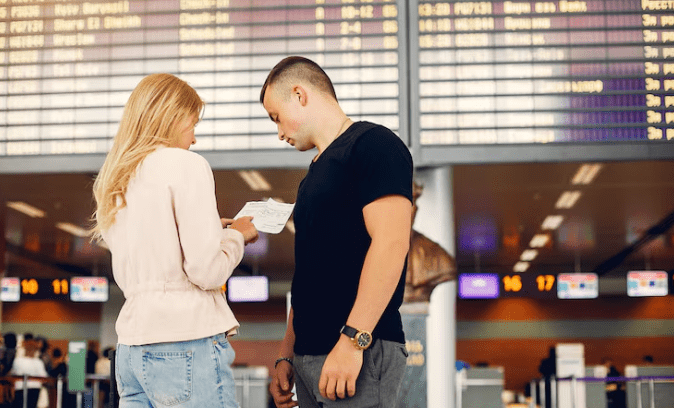
At half past seven in the morning, Kiera reached the Linate airport in Milan. It wasn’t until eleven that she took off. She had arrived early, had her passport, and had plenty of time to spare, so by all accounts, she had done everything correctly. Standing in an unmoving line at the age of seventeen, she was already feeling ill from what she thought was food poisoning. When the departure board displayed her gate at ten minutes to eleven, a border guard turned to face her and calmly informed her that her flight had already departed. Thirty or so people boarded the aircraft. A hundred or so did not.
The detail that sticks out is that one. Thirty travelers successfully passed through border security. One hundred didn’t. The plane departed despite the same flight, the same morning, and the same line. On Sunday, April 13, EasyJet flight EJU5420 to Manchester took off from Milan Linate, leaving 122 people standing in a terminal hall, some of them passing out and others throwing up from the heat, all of them attempting to make sense of what had happened to their day.
EasyJet — Milan Linate Stranding Incident, April 2026
| Airline | EasyJet plc — Low-cost carrier, headquartered in Luton, UK |
| Incident Date | Sunday, April 13, 2026 |
| Location | Milan Linate Airport, Italy |
| Flight Affected | EJU5420 — Milan Linate to Manchester Airport |
| Passengers Stranded | Approximately 122 passengers were left behind |
| Queue Wait Time | Up to 3 hours at the EU Entry/Exit System (EES) border control |
| Cause | EU Entry/Exit System (EES) — fully operational from April 10, 2026 |
| EES Launch Date | October 12, 2025 (started); April 10, 2026 (fully operational) |
| Compensation Offered | £12.25 reported by one stranded passenger |
| Reference | BBC |
Three days prior to the chaos at Linate, on April 10, the European Union’s new Entry/Exit System, or EES, went fully into operation. This is the official cause. Every time a traveler enters or leaves the Schengen area, the system requires biometric information from non-EU citizens, such as fingerprints and facial scans, obtained at border control. This introduces a layer of processing that did not exist prior to 2025 for British passengers, who are by definition citizens of third countries after Brexit. A passport stamp and a border officer’s glance, which used to take only a few seconds, now require a scanner, a camera, and processing time that rapidly increases when hundreds of passengers are attempting to depart at once.
The mechanics of what transpired are almost unremarkable, which is exactly why it seems so preventable. The terminal halls were lined with people. The temperature rose. Ten minutes before their planned departure, water was delivered to passengers at ten-fifty, as if that were a sensible replacement for an operational border system. The plane then departed. When travelers are under pressure, it’s difficult to ignore the discrepancy between what airports actually deliver and what they promise.
To be fair, EasyJet’s response was measured and mostly correct. The airline claimed that the circumstances were “outside of our control,” that it had attempted to hold flights, and that it was providing free transfer flights to passengers who had missed connections. Most likely, all of that is accurate. Passport control booths are not manned or staffed by airlines. However, EasyJet’s automated response offered Kiera £12.25 when she emailed to explain that her family would now have to pay £520 for new flights—to Gatwick, not Manchester, meaning additional train costs on top. Reasonably, she pointed out that this would not cover the cost of a sandwich at the airport. Until the next day, she would have to sleep on the floor.
Even if EasyJet wasn’t at fault for the queue, they might have managed the fallout more quickly. These are the times when an airline is remembered—not the seamless Sunday departures, but the emergency Sundays when travelers are stuck and require a real person to answer the phone. More people will see the £12 figure on social media than any press release regarding biometric processing times.
Aviation observers have been looking forward to this bigger picture for months. EasyJet’s CEO and other industry leaders had warned about terminal saturation if border authorities didn’t carefully manage the rollout of EES, which was first announced well in advance and launched in limited form in October 2025. Apparently, Linate disregarded those cautions. It’s still unclear if this was just the first bad weekend of what could be a longer adjustment period, if the airport was understaffed, or if there weren’t enough EES lanes to handle the volume of Sunday departures.
Milan wasn’t by itself. Similar congestion has been reported from Bergamo and Malpensa, suggesting a systemic problem rather than the failure of a single airport. Travelers report spending more time in line at the border than in the air, which shouldn’t be happening at all on a quick trip like Milan to Manchester.
As this develops, it seems as though Europe has constructed a new border system without fully considering the physical location of all those additional processing minutes. They form lines. into the corridors of the hot terminal. A 17-year-old from Oldham was found sleeping on airport bags while waiting for a flight to the incorrect city. She was holding a £12 voucher and wondering what she had done incorrectly.
She didn’t do anything wrong. That’s the part to keep in mind.