
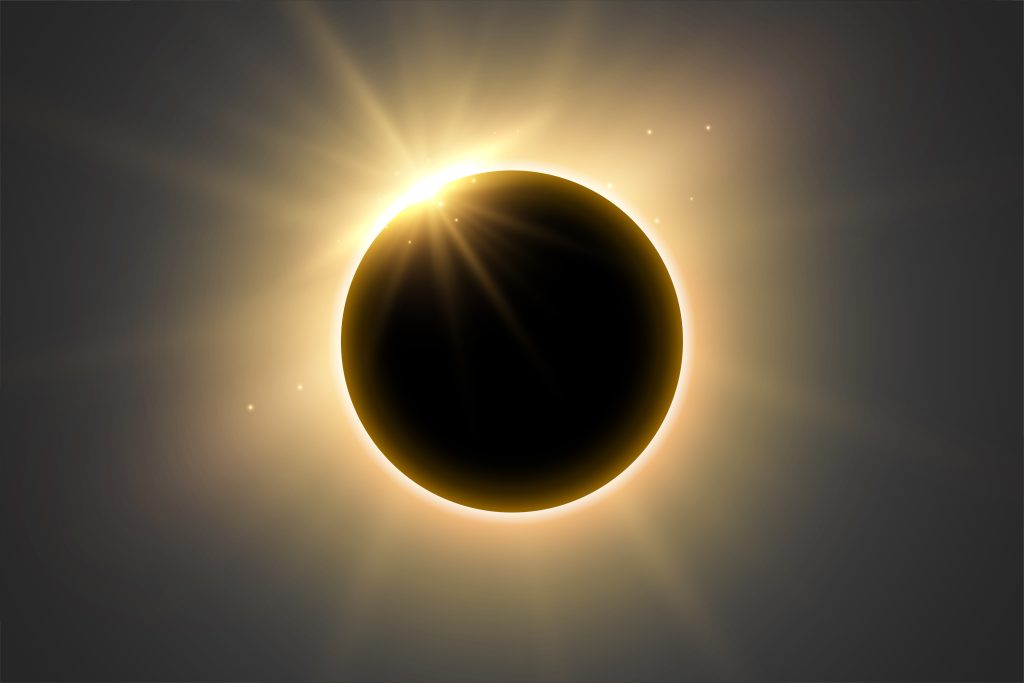
It’s early in the morning in Antarctica, where time seems to stand still and solitude is a constant companion. That silence will be broken on February 17, 2026, by an extremely uncommon sight: a ring of fire illuminating the polar sky.
This eclipse isn’t the type that pulls thousands of people to open fields or throws cities into complete darkness. Since it’s an annular eclipse, the Moon is slightly too far away from Earth to totally hide the Sun. A flawless, flaming ring is the end result. This time, it can only be fully viewed from one of the world’s most remote locations.
| Date | February 17, 2026 |
|---|---|
| Type | Annular Solar Eclipse (“Ring of Fire”) |
| Coverage | Moon covers 96% of the Sun |
| Duration | Up to 2 minutes and 20 seconds of annularity |
| Maximum Visibility | Remote Antarctica (Concordia and Mirny Stations) |
| Partial Visibility | Southern Chile, Argentina, and parts of South Africa |
| Viewing Safety | Eclipse glasses required at all times |
| Cultural Significance | Aligns with Chinese New Year and start of Ramadan |
| Next Major Annular Eclipse | February 6, 2027 – Visible in South America and West Africa |
An annular eclipse necessitates protection throughout, as contrast to a total eclipse, which allows spectators to experience a brief moment of safe, unaided amazement. The Moon is framed by the Sun’s piercing circle of blazing brightness, which never goes out.
On the Dome C plateau, Concordia Station, run by France and Italy, will provide one of the greatest views. The Russian base at Mirny on the Davis Sea will also be affected. For a limited time, these outposts—which normally house fewer than a few hundred people combined—will be front-row seats to one of the most spectacular celestial events of the decade.
The partial eclipse phase will start shortly after daybreak for people in southern Chile or Argentina. A small portion of the Sun will disappear as the Moon moves into place, casting a gentle, unsettling shadow across the terrain. Near the horizon, parts of South Africa might catch a glimpse of the same occurrence.
The cultural timeliness of this occasion adds to its intrigue. The eclipse occurs at the same time as the new moon, which signifies the start of Ramadan and the Chinese New Year. Calendar, science, and symbolism all come together in a way that seems remarkably synchronized.
Because the Moon is close to apogee and seems just small enough to allow the Sun to peep around it, annular eclipses are based on balance. These are very accurate instances. The memory of that ring of fire endures even if it only lasts for two minutes or possibly a bit longer.
I witnessed one unfold over a Nevada desert plain years ago. The light completely altered the character, but the shadows didn’t get any deeper. The air around us felt, for a minute, thinner, as if the sky had exhaled, and it sharpened somehow.
In 2026, the Antarctic ice sheets will be touched by that same bizarre atmosphere. No crowds. No traffic. Only a few hundred fortunate people, the Sun, and the Moon are present.
Annular eclipses present fewer opportunities than complete eclipses from a scientific standpoint. There is no darkening profound enough to detect stars, and there is no corona to investigate. However, the alignment itself—so precise, so fleeting—continues to captivate.
This time, the annularity’s route is around 760 kilometers wide and crosses snowy terrain with more frequent wind than is seen. However, the geometry will be flawless. The Moon will block out almost all of the Sun’s core, leaving behind a luminous outline that is impossible to simulate.
Millions of others who are unable to travel to such remote locations will probably watch the event live. However, even people who are observing on screens can understand what is being place. The solar system briefly arranges itself into a piece of art as it rotates, as it usually does.
That level of constancy is comforting.
The eclipse in February, one of the four big eclipses in 2026, is notable for its beauty. It isn’t dramatic in the typical sense. It’s more understated, like a minimalist sculpture that only those who take the time to look closely can appreciate.
This type of ring of fire won’t occur again until 2027, when it crosses portions of Ghana, Nigeria, and Brazil. That one will be easier to get to, and perhaps even packed. It won’t be this one, though.
This occasion feels especially important because of that.
Even though it takes place far away, it nonetheless encourages introspection. We may stop and glance up, even from our phones or living rooms, and know that there is a dazzling ring glimmering in the Antarctic sky, serving as a reminder that light can bend around darkness to produce something remarkable.
Some things are simply worth being aware of. even if you are unable to physically observe them.