
Tai Chi walking surreptitiously made its way out of the community center and onto the internet at some point in the last six months. Millions of people have watched videos of it, which feature slow, deliberate, almost meditative movement patterns set against park or living room floors. AI-generated characters with unlikely muscles can be seen in some of the clips. Some claim that spending seven minutes a day will change your body. That’s mostly noise. However, there is something truly worthwhile to comprehend hidden beneath the algorithm bait.
Fundamentally, Tai Chi walking is a stepping method derived from traditional Chinese martial arts. On its own, it is not a full Tai Chi practice. Consider it a single chapter from a much longer book; it is significant and helpful, but it does not tell the whole tale. The way the movement functions is by substituting something much more deliberate for the haphazard mechanics of everyday walking.
Momentum does a lot of the work when walking normally. You sort of fall forward onto the next foot after pushing off one. Walking in Tai Chi eliminates that momentum. After establishing balance and shifting your entire weight onto one leg, you carefully place the empty foot, heel first, and only then roll your weight forward. Every action is taken into account.
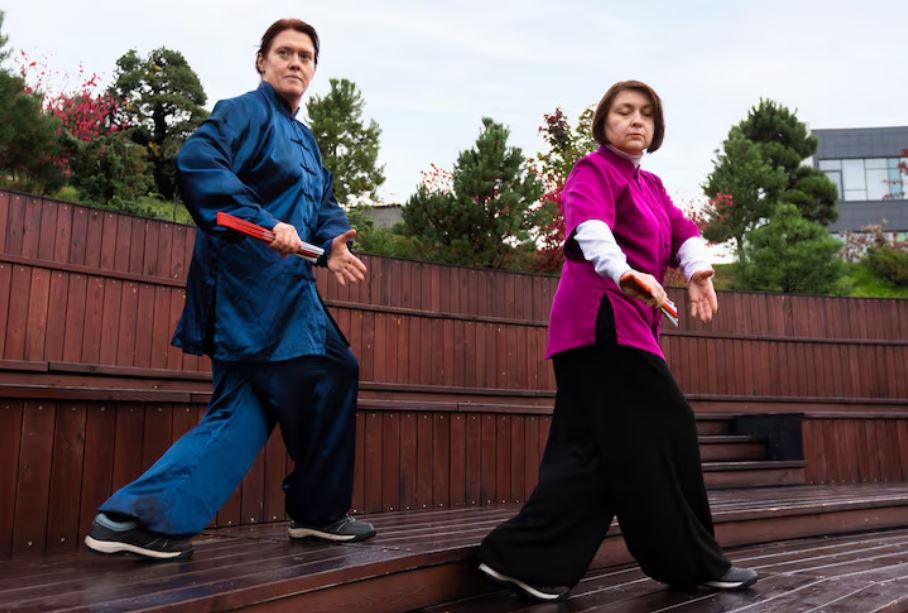
It sounds almost comically slow. Indeed, it is. That’s part of the point. Your muscles and nervous system are forced to work in ways that regular walking never requires because of the deliberateness. It is the most basic movement in Tai Chi training, according to Feng Yang, an associate professor of biomechanics at Georgia State University. That framing is important. Before allowing students to approach a complete form, Masters used to require them to practice these stepping patterns for months. That patience made sense.
Though not quite as dramatic as the viral content suggests, the physical benefits that research keeps revealing are real. The main finding is improved balance, which is significant because falls continue to be one of the main causes of serious injury among older adults. The type of single-leg stability that catches you when you trip appears to be genuinely trained through repeated, gradual practice of controlled weight transfer.
Because the technique requires proper knee, hip, and spinal alignment in every step, joint health also improves. Additionally, practitioners add a breathing component to the movement. This diaphragmatic technique is said to enhance lung capacity and stimulate the parasympathetic nervous system. It’s still unclear if the final section applies to casual practitioners.
It’s difficult to ignore the discrepancy between the benefits of Tai Chi walking and what social media has chosen to promote. A few weeks ago, Leda Elliott, a Tai Chi instructor at an assisted living facility in Massachusetts, encountered this firsthand when a man entered her class and claimed to have seen on YouTube that he could gain muscle. From this, he couldn’t. However, it’s not insignificant that he came at all, interested enough to try something different in his later years. That seems to be the more real version of what this practice offers, which is a recalibration rather than a physical transformation. A slower, more grounded, and possibly more sustainable approach to life than most things people try in a gym.
Depending on the person, it may or may not lead to a deeper place. The Tai Chi for Health Institute’s founder, Dr. Paul Lam, likens Tai Chi walking to a single food item in an otherwise well-balanced diet. He contends that the full practice is the full meal, improving posture, coordination, trunk control, and mental focus in ways that walking alone cannot. That seems correct. However, a single deliberate and well-executed step is still a step forward for someone who is just starting, has no prior experience with Tai Chi, and has no particular desire for complexity.
FAQs
1. What is Tai Chi walking?
A deliberate stepping technique from Chinese martial arts training focused on mindful weight transfer.
2. Does Tai Chi walking actually improve balance?
Yes — repeated controlled weight shifts build single-leg stability that helps prevent falls.
3. Can Tai Chi walking replace a full Tai Chi practice?
No — it’s a foundational element, not a complete substitute for full Tai Chi sets.
4. Is Tai Chi walking suitable for older adults?
Yes, it’s low-impact, joint-friendly, and requires no equipment or prior fitness experience.
5. How is Tai Chi walking different from regular walking?
It removes momentum entirely, requiring conscious balance on one leg before each step.